A couple of months ago, I was sitting on a panel answering questions at the London Music Ministry Conference.
I never answer questions very well, but those times always give me a chance to explain in these articles what I would have liked to have said on the panel if I’d have had the time or clarity of mind.
The question that I fluffed this time was one about how to help people respond emotionally to spiritual truths through music without manipulating people to make superspiritual responses.
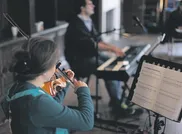
I think that this is one of the most common issues faced by church musicians, and a tightrope (see pic!) that we have to walk every time we pick up our instruments. As evangelicals we are rightly concerned not to manipulate emotions which can be wrongly taken to be an assurance of the presence of God. But we can tend to over-compensate by producing music that is drab and lifeless. This similarly can ‘manipulate’ equally wrong emotions of boredom, indifference or even false reverence.
Music rightly moves us
God has certainly given us music as something that moves our hearts not just to remember truths, but to respond emotionally to them — ‘I sing for joy at the work of your hands’ (Psalm 92.4, NIV). Thanksgiving, joy and lament are just three emotions that Christian songs are meant to instil in us. Now, simply the fact that a song of lament will most likely be written in a minor key will automatically lead to a more subdued response. Is this manipulation? I don’t think so, but it’s a tricky one! It would also be worth saying here that our preachers face the same problem — when a preacher encourages a response to a truth, he has to make the same call about whether he is manipulating his congregation through his use of words or the inflexion of his voice.
We are all different
I’ll say up-front that it’s something that we will never get right as musicians. This is because each person responds differently to different stimuli, sometimes according to their own taste in music, sometimes according to temperament. A drummer may move someone’s heart to feel joy, while someone else only experiences anger at exactly the same moment. Once, after I played the organ for a hymn, a man in his 20s felt the hairs rise on the back of his neck. Another man in his 50s said: ‘Can’t you burn that thing?’ At a carol service last year I accompanied a children’s choir on a plinky-plonky keyboard playing ‘Hark the Herald’. A member of the congregation said that he definitely felt ‘anointed’ by my playing. I can’t even remember playing any ‘anointed’ chords. (Yes, it’s hard to believe, but there are some chords that are considered to be especially spiritually anointed!)
Avoid over-cooking
The point is that you can’t guarantee how a diverse group of people will respond, whatever age, stage or theology. I think that this is a good thing — I’m always suspicious of a church meeting where everyone is responding to the music in the same way, as usually this means that they have chosen their church because that particular style of music helps them respond in a way that other styles don’t. I’m happy that some are not comfortable with the style of music that I produce, because it shows that they are there to be moved by the Word of God rather than wanting to be ‘anointed’ by the music.
Having said that, some are often moved by the music, and I’m always pleased if this reflects a movement to a greater heart-felt devotion to Jesus. However, I try always to be conscious not to over-cook things musically — and if I ever do I’m glad to have the safety net of a boss who would readily haul me up if I got out of hand.
The important thing for musicians is to pray that we’d always have an attitude of service, thereby keeping a check on our motives in the way that we play and sing. This helps us to keep walking the tightrope (see pic again!) of helping people to respond to Jesus passionately in singing without fretting that they’re getting too passionate!