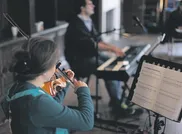
At the beginning of July just under 40 professional performance artists came to our house for a barbecue.
Mostly musicians, with a couple of actors, they were from a wide variety of churches and came with different levels of Christian maturity, some having been drifting spiritually. I spent the morning finishing off preparing a short talk on Philippians 3 for the evening, and praying for the rain to stay away. The rain didn’t stay away, but amazingly we were able to fit all 38 of us in our kitchen for the talk.
Source of personal assurance
I took Philippians 3, because here Paul makes very clear that his spiritual standing is given to him only by Jesus and not by his human audience, who revere him because of his religious status. Performers are always tempted to look for their personal assurance from their audience, and often they can take this into their spiritual life. My own personal testimony is that I’m always tempted to look to my past spiritual pedigree and my present spiritual standing as a church musician. God has encouraged me daily, through Philippians, to count those things rubbish so that I may gain Christ. Finding that our righteousness can only ever come from Christ alone is a real reason for rejoicing — I’ve been a lot cheerier these days. If you’re feeling a bit low and a bit unloved as a church musician, I can very much recommend reading Philippians to cheer you up!
I’d asked three of the musicians to prepare answers to one question each to help us apply what we’d learnt. David Goode (organist) told us how he’d learnt to receive and deal with human praise. Jacques Imbrailo (principal opera singer) told us how we can aim to be the best we can be, but without making music into an idol. Finally, Simon Hallett (double bass player at the Royal Opera House) talked about how he’d been tempted to rely on his own spiritual and musical pedigree for his justification in God’s sight. All of them faithfully drew us back to Philippians 3 by reminding us not to look for our identity in the music we play, or what our audience thinks of us. They told us instead to remember that our identity is always and only ever found in Jesus — as we count everything a loss compared to the surpassing greatness of knowing Christ Jesus our Lord.
It’s a privilege to know these men who, though they are such consummate and successful professionals, acknowledge that the only thing they have to offer God is their sin. In God’s sight this puts them on just the same level as the church guitarist, the grade 2 pianist and the alto in the choir (whatever human critics may say). Philippians 3 also reminds us that we all play, sing, and live our lives in front of an audience of One who sees our status as gain or loss solely on whether Jesus, by his grace, has called us to be his children.
Leeds piano competition
Reinis Zari is a Christian brother with whom I’ve had the privilege of reading the Bible one-to-one. Reinis has recently been awarded the Great Music Award of Latvia — the highest national state recognition in the classical music field — and has won top prizes in 11 international competitions. He’s off to play in the Leeds piano competition in September. This is what he wrote on his website: ‘Here is something that I wish for, and that you can wish me as I compete: St. Paul writes: “Do you not know that in a race all the runners run, but only one receives the prize? So run that you may obtain it. Every athlete exercises self-control in all things. They do it to receive a perishable wreath, but we an imperishable”. I wish that I would desire this imperishable wreath more than those that men give each other’.
Please pray that these men, along with other Christian professionals in the performing arts, will be found in Christ, having the righteousness that comes from God alone, and that they will work for the prize and glory that never fades.
Richard Simpkin is Director of Music at St. Helen’s Church, Bishopsgate, London.