Christmas, as well as being great evangelistically, is also a good time to model how to sing congregationally.
Having experienced so many other types of church music, it’s struck me that evangelical church music is very distinctively congregational, and this should be hugely attractive to visitors at our carol services, who come because they want to sing.
Just an audience?
Strangely, it’s rare that people are expected to sing when they come to a church these days. Most church traditions encourage a performance-driven meeting, where the congregation either simply listens or has minimal participation. The congregation is treated like an audience. Having been brought up as a cathedral chorister, I was very aware that most had come to listen to the choir sing. Some used the music to help them experience something spiritual. Some, I’m sure, listened to the words and meditated on them. Others used the music as an opportunity to switch off from the outside world for a bit or be entertained. One of the cathedral congregation members forwarded me a YouTube clip of an opera singer, whose performance he said was much more spiritually uplifting than having to sing interminable hymns. It was clear that music wasn’t supposed to be used by the congregation to serve the congregation. That was left to the professionals.
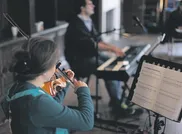
It’s a similar story with the more contemporary ‘worship’ services, where the professionalism of the band, the sound levels on the PA system and the complexity of the songs mean that if you attend one of these events and you look around, arms may be in the air, faces may be intense, but not many will be actually singing their hearts out, in encouragement of each other.
Performance not participation
This came a bit clearer to me when I went on a training day put on by the company who installed our PA system. I’d gone expecting to work hard at making the spoken and sung word as clear as possible. Instead, we spent most of the day learning how to mix a band so that you could hear all the instruments. I said to the trainer that we were much more interested in being able to hear the congregation, as that seemed to be the reason that we sing together — to encourage each other as we sing praise to God (Ephesians 5.19-20). In response, he said that in the Old Testament temple there would have been so many trumpets, instruments and singers that you probably wouldn’t have heard the rest of the people sing. He was, therefore, urging us to see church music as more of a performance than something that encourages participation.
Singing as one
Of course! Again, the practices of our New Covenant community were being defined by Old Testament principles, as if nothing has changed since Jesus liberated us from the temple rites. What I hadn’t quite got clear in my head till then is that churches that buy in to this model aren’t very interested in people singing to Jesus at all. They’re more interested in ‘worshipping God with their gifts’, being as professional sounding as they can be, ‘serving’ the church with their music. It sounds so God-focussed, but actually God’s people are being short-changed as they stand in the audience, because it’s only if the band is good enough, or if the PA settings are just right, that they may be ‘drawn in’ and included in the show.
Congregations of the New Covenant are those who sing truth to God together so that they are built up in that truth, and so that non-believers see us singing truth together and are driven to their knees in repentance (1 Corinthians 14.24-25).
Carol service
Isn’t this what our carol services are all about? As evangelicals, we want unbelievers to hear Christian voices proclaiming the best news in the world with all our hearts. We want them to see our faces overflowing with love and joy in our Saviour born to earth.
Of course, there’s a place for things to be sung for reflection — we don’t have to join in all the time, but, when our carol services turn into concerts, then we’re not only selling ourselves short, but also the very people who need to hear us proclaim, ‘O come let us adore him — Christ the Lord’!
Richard Simpkin is Director of Music at St. Helen’s Church, Bishopsgate, London.