First of all, something huge to give thanks for.
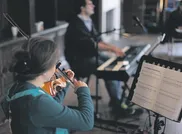
A third year cellist from the Guildhall School of Music and Drama put his trust in Jesus this week. Thank you for praying in the light of the mission I wrote about last month, and praise the Lord for his grace.
As it happens, it’s grace I want to talk about this week. We’ve just had one of the clearest and most edifying set of sermons that I remember in my 18 years at St. Helen’s. We’ve been taught Galatians, where the preachers have picked their way through the complexities of law and grace with sensitivity and clarity. At the same time they have been bold to confront those who would love to see us submit again to a yoke of slavery.
Adding to grace?
It’s got me thinking about the ways that I am tempted to add laws to the grace that has been poured into my heart, and the ways that we can use music and church events to fuel those laws.
A lot of these laws stem from good ideas, which, having been good ideas at the time, become such a part of the fabric and nature of our meetings that there would be uproar if we shook them off, even if we wanted to shake them off. I’m thinking about carol services, children’s slots in church meetings, the early morning Book of Common Prayer service, etc.
Traditions which dominate
Of course, we’d never think that these things in themselves deny the gospel of grace, which was the Galatian heresy. I also don’t want to suggest that by putting on carol services we’re committing that same heresy! However, it would be good to review how much a desire to live by grace drives our activities, or whether we let the events themselves take the driving seat.
On the surface, the events we put on and the music we use are all either good opportunities for evangelism (e.g. carol services), or because they help everyone to feel included (e.g. children’s slots).
But children’s slots in services. Inclusive? For children maybe, but I’ve met people who find the songs and actions to be patronising, exclusive and irreverent, especially if they are run by someone whose gifts are in teaching adults, not children.
And carol services. ‘We must have a choir for the carol service.’ Must we, when those who are at the pre-service rehearsal are the very people we want to be meeting friends to bring to the service? ‘We must have a Sunday School nativity play.’ Must we, when we have to start rehearsing in late September? ‘We must have a carol service.’ Must we? I might have overstepped the mark with the last one, but I’ve heard of at least one church which has done away with carol services because they thought that it was an underhand way of getting people in the building to listen to the gospel, when all they think they’re going to be doing is singing a load of carols. The church may or may not have got it wrong, but at least they’d thought about it, and don’t want their church programmes to control the way they communicate grace.
There are nearly always good reasons for the things we do, so we don’t need to stop doing them. That’s not the point here. The point is about whether our events are controlled by communicating the grace of God or whether the events control us. So please don’t pull the plug on your kids’ slots! Just realise that you are free not to do them. Similarly, keep those carol services, but not if it’s simply to ‘observe days and months and seasons and years’ (Galatians 4.10, ESVUK).
Overall, let’s pray together that the grace of God who came down to earth would be proclaimed all over the world this Christmas — whether that be at carol services or in our homes, whether accompanied by choirs, organs and brass bands or by Jonny’s new kazoo. And let’s pray that there would be more like the cellist I mentioned who would take hold of the freedom that only Christ can bring. Happy Christmas!