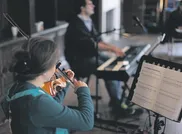
It was the end of August and I was privileged to be asked to speak to my own congregation about ‘How music builds the church’.
Teaching about music is good for a church musician to do every now and then, because it’s useful for the congregation to hear the work and thought that goes in to putting a service together. Also, it forces the musician to re-evaluate and articulate publicly to his/her own congregation the reason for doing the things the way we do. I often speak to other churches about music (someone said that my talk should be able to give itself by now), but your own congregation is a bit of a different bag. I found myself spending hours in preparation making sure that I was letting Scripture form my theology of music rather than the many voices I hear every week.
Music serving the Word
However, the main reason it’s good to speak on music is to take the congregation’s confidence off music and onto the Word of God. It shouldn’t be a surprise that one of the first things I said was that music doesn’t build the church. The church is built as God works powerfully by his Spirit through the Word and prayer. Music can help by serving the Word of God and prayer, but as soon we start to rely on music to define our identity or unity then we build the church on the sand and not on the rock.
The talk I did is on the St Helen’s Bishopsgate website. It’s audio only, as I’m not presentable enough for video.
Top tips
If you are thinking of doing a similar talk, just a few tips. First, be as passionate and positive as you can be about Jesus and the power of the Word of God. Colossians 3:15-17 is peppered with exhortations to thanksgiving for the Christ-centred unity we enjoy when we sit under the rule of Jesus.
Second, don’t be afraid to deal with the negatives – e.g. that music cannot direct the Holy Spirit or bring us into the presence of God. Sometimes this view can make people a bit cross, but it’s always a kind thing to highlight what music can’t do, as we want an assurance of God’s presence to be shifted from the heart of man and onto the Word of God. As ever, negatives help to highlight the positives.
Third, try not to suggest in any way that one particular style of music is more appropriate than another. There will be those in the congregation with all sorts of frustrations (why don’t we have a choir? Why do we have a choir? Drums – ugh! Why don’t we raise arms? Why don’t we have a worship leader? etc). As soon as you go down that route, that will be all your hearers remember about the talk.
Convictions
Ultimately, I try and send people away with these convictions:
• Assurance that, if they are Christians, they belong to Jesus, and the Holy Spirit lives in their hearts, whatever they feel (good or bad) about the music in church.
• Commitment to pray for their pastors and the ministry of the Word through speech and music in their church.
• Discernment about what builds the church, so that if they ever leave, they know to look for a church that will feed them the Word of God, and not one that necessarily feeds their musical tastes. (If they find a church which teaches the Bible and they love the music, they’ve hit double top).
• That they know that you love them – i.e. that any decisions taken about music aren’t a personal hate-campaign against them, but to serve the wider congregation and those seeking to find out about Jesus.
I wouldn’t suggest taking a Sunday sermon to speak about music – that’s when the pastor needs to be teaching as he has been called to do. I just spoke to all those who are in weekday Bible studies, as they are the ones who, with the Word of God in their hands and richly dwelling in their hearts, build the church (Ephesians 4.12).