Evangelical churches need to decide.
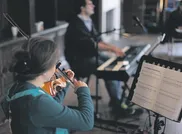
On what? Well, whether our church musicians are performers helping an audience appreciate our art, or whether they are fellow servants helping a congregation to sing and respond to the Word of God.
There has been a slow but steady creep towards the performance/audience model over the last 40 years, driven by all sorts of factors. On a practical level, driving forces have been Christian conventions where professional bands are employed; popular congregational songs that are written for CD/mp3; the simple fact that we have replaced the ‘sanctuary’ with a stage.
Theological factors
Those are practical factors, but there are also theological factors. Many actually believe that the performance/audience model is validated by the way music was used in the Old Testament temple. ‘With all those trumpets and cymbals’ they say, ‘no one would be able to hear the congregation anyway, so why shouldn’t church music be a performance?’ This model, of course, is used in our English cathedrals, where the congregation goes to listen to the choir sing canticles, psalms and anthems, and rather dread having to stand up and join in for the hymns. When I was a cathedral chorister I remember thinking that the hymns were a bit second-rate, as the riffraff in the congregation had to join in, bringing the standard down and cramping my style.
New Covenant norm
For New Covenant believers, I think the Bible is clear that we have a different model that we need to protect and prosper. The whole idea of the Christian gathering is for us to be taught the Word of God and then for the people of God to respond together, speaking and singing truth which builds and admonishes Christians, while also proclaiming God’s glory (Ephesians 4.11-16, Ephesians 5.19, Colossians 3.15-17). For this reason it seems as if the way music was used in the temple has now been superseded, and should now be much more corporate in nature. It’s not necessarily wrong to sing a song where the congregation simply listens, but the norm should be for the congregation to be able to respond together, ‘truthing’ each other with the Word of God.
Congregation centre-stage
Here are a few ways that we can promote congregational participation rather than the performance model: sure your new PA system is
1. Make installed by those who understand that the most important element of the meeting is the preaching of the Word, and not the sound quality of the music. However much sound companies try and convince us that their top-of-the-range system can serve both ends, it can’t.
2. Sing songs that your congregation can sing well and confidently. A good person to ask on this one is a man who either can’t or doesn’t like singing. Many songwriters today write songs which serve the performance model, so either normal people can’t follow the tunes, or the notes are outside the average vocal range. Here’s a snippet from a random blog I came upon a couple of weeks ago: ‘the key doesn’t matter much to the person off the platform anyway – they’re not actually singing. Humanity has always loved to listen to the high voices (name some famous tenors... now try to name a famous bass), so we buy the music of Christian artists with their lovely high-pitched (and unique) voices, then we ask our worship team/band to do those songs the same way, so we can stand and listen to them, and enjoy their worship.’ Great to have a blog that illustrates exactly the point I’m making!
3. Musicians: keep intros, links and outros to songs to a minimum. As long as people know when to start and stop singing, then the job’s done.
4. Encourage those leading meetings and music not to draw attention to themselves (dress, gestures, language, eg the use of words like ‘stage’, ‘platform’, ‘you’).
5. Train musicians and PA operators to set volume levels that give a strong support to the congregational singing without drowning them out. The voice of the congregation should be the strongest in the mix.
I wouldn’t go to the stake over this issue, but in the New Creation we’ll all be singing together, along with all the victorious saints, so we might as well get practising now.