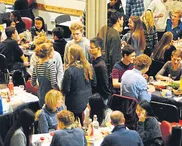
Kate Duncan and relay worker Joanna Robertson share five ways
Over the last three months, more than 38,000 students have attended a university Christian Union mission week event.
These focussed weeks of evangelism include daily lunchtime dialogues, evening meetings and a host of other events to draw in students. For many non-believing students, these weeks represent a significant opportunity to hear the gospel, often for the first time.
Around 100 mission weeks have taken place across the UK, involving even more CUs, and stories of students turning to Christ are still flooding in. Here’s a glimpse of how they did this during these weeks.
1. Digital engagement
50% of 18–24 year-olds go on Facebook as soon as they wake up. So digital platforms are harnessed by CUs. Tens of thousands of students have encountered CUs, and the gospel, via social media recently, with many CUs reporting students turning up to their events having read a blog post or seen a video.
‘Ben’ attended Durham CU’s Monday evening event having had his interest piqued by reading a student testimony online. He was struck by the reality of the gospel and gave his life to Christ that night. He has since become part of a local church and is reading the Bible for the first time.
2. Storytelling
‘Everyone has a story. What’s yours?’ Personal stories of faith are a powerful way to engage with Christianity. Durham CU made this the focus of their Story mission week, and shared portraits and interviews with students from a range of backgrounds and perspectives. One non-believing student commented: ‘Everyone I spoke to was … willing to share their story, to ask questions and to patiently answer yours. [It] made me question the preconceptions I held about Christianity.’
For two weeks Manchester CUs counted down the days to their city-wide mission with a different testimony blog from a CU member each day, and CUs in Edinburgh, Sheffield and Exeter shared testimonies across social media throughout their mission weeks.
3. Post-lunch lull café
Cambridge CU’s answer to the post-lunchbar lull was the ‘No Filter Café’, featuring discussions and filter coffee. Hosted in a central location, it provided a space where students could continue conversations sparked by the talks, as well as picking up relevant books to explore matters further.
Having been gripped by a talk the previous day, one Cambridge student went along to ask questions and continue discussing. Later that day, after a long conversation with his friend in the CU, he asked: ‘Well, what do I do now?’, after which they prayed together and he accepted Christ.
4.Cereal bar
Kingston CU filled a gap in the market with their innovative approach to publicity: the cereal bar. Following the recent closure of a local cereal café / student hangout, they set up a stall on campus to give out cereal to hungry passers-by. In return, students asked their questions about God and were given a flyer for the week’s events.
‘We had a number of good conversations’, says Ollie. ‘People could spin a coloured wheel and land on a topic, such as love or justice, and then we talked about that issue, trying to point them to Christ.’
5. Year-long follow-up course
What started as a six-week follow-up course in February last year is still going. Oxford CU are running a discussion group in a local coffee shop, with live music, free coffee and cake. Widely advertised at last year’s mission week, it began running two nights a week in February 2015.
Now called ‘The Search: Encounters with Jesus’, it provides a year-round opportunity for Christian students to bring their friends to a relaxed environment where they can study the Bible, ask questions and discover who Jesus is. One local church worker says: ‘I am enormously encouraged … my table alone has witnessed a nominal Christian clearly became a committed disciple, a non-Christian from a Christian home now ‘halfway there’, and two atheists who are intellectually curious coming along.’