TOLKIEN
Director Dome Karukoski
Cert 12A 112 mins
So great is the bounty with which [the Christian artist] has been treated that he may now, perhaps, fairly dare to guess that in Fantasy he may actually assist in the effoliation and multiple enrichment of creation. All tales may come true; and yet, at the last, redeemed, they may be as like and as unlike the forms that we give them as Man, finally redeemed, will be like and unlike the fallen that we know. JRR Tolkien
It takes little imagination to consider a world in which Tolkien the film never exists because Tolkien the man never makes it out of a French battlefield alive. Another ricochet, a recalibrated mortar shell, a slight tactical misstep, and one may swap the deaths of Robert Gilson or Geoffrey Bache Smith – two of Tolkien’s best friends, both killed at the Battle of the Somme – for John Ronald Reuel Tolkien.
But Tolkien survived. And Tolkien exists. The new film details the formative years of Tolkien’s (played by Nicholas Hoult) life, highlighting how his various roles forged him into the writer he would become.
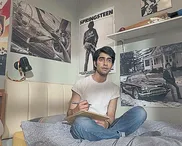
He’s a child whose mother passed down a vocabulary that effortlessly employed words like ‘impecunious’, and also a penchant for the enchanted. Then he’s an orphan, a misfit among his well-heeled peers. He’s a precocious eccentric, scribbling mythical creatures on his wall and devising mythical languages in his notebook. He’s a friend, one quarter of a band of artistic brothers (the Tea Club, Barrovian Society). He’s an optimistic dreamer: ‘We want to change the world through the power of art,’ he exclaims, in perhaps the film’s least eloquent moment. And yet he’s also squelched by circumstance, forced for a time to pick between his love for Edith Bratt (Lily Collins) and his future at Oxford. As the choice rends them in two, she reflects on their mutual predicament: ‘I let myself believe there are happy endings for people like us. But there aren’t. There can’t be.’
Karukoski shows us all of this through flashbacks, riveting Tolkien’s perspective to the present-day – where he’s mired in the muck of trench warfare. The germane bits of Tolkien’s past are recollected from there. In the present, he’s wandering around the Somme in a kind of fugue state, looking for his dead friend Geoffrey. Sometimes he’s alone, sometimes he’s surrounded by dying men. Karukoski asks a lot of one character, but it’s unclear if he’s real or imagined.
Dragons and ringwraiths
In most of these battlefield moments, it’s hard to distinguish Tolkien from any other war epic – that is, until soldiers’ flamethrowers turn into fire-breathing dragons and men begin to die due to a dark mist that reminds the keen viewer of Frodo’s biggest fear: ring-wraiths. This stylistic embellishment serves a purpose: Karukoski wants us to see how Tolkien’s experience in war not only caused him to recollect his past; it also coloured his future world – both real and written, both England and Middle-Earth. It’s an unsubtle, yet effective piece of film making.
One does not need to have read Tolkien to enjoy Tolkien as a stand-alone story. It doesn’t require prerequisite reading, but it may require prerequisite affection. If you’ve never heard of Tolkien or The Hobbit or The Fellowship of the Ring – if you’ve never seen Peter Jackson’s film adaptations to give you even a nascent understanding of his world – then I wonder if this film will feel strange and even a bit slight, leaving you lost and unmoved.
Tolkien’s faith
The Christian viewer will wonder what the film does with Tolkien’s devout Roman Catholic faith. The answer: mostly nothing. Apart from the priest who reminds Tolkien that he can’t marry Edith because she’s not Catholic, Tolkien’s faith is both unseen and unheard. I don’t mean to say that it’s dismissed or denied; it simply isn’t there. I can’t recall the name ‘Jesus’ being uttered even once.
Some might consider this deceitful, but I disagree. After all, the film focuses on Tolkien before he’s 25. I’m no Tolkien scholar, but I’m not sure how deeply his devotion to the Church ran throughout his teens.
Furthermore, I’m not precisely sure what one desires in seeing more of his faith on screen. Confessions to his priest? Attending Mass? A long speech about how The Lord of the Rings is ‘fundamentally a religious and Catholic work’? Such choices would have come across as affectations, and nauseatingly so. Far better, in this reviewer’s opinion, to let Tolkien’s faith lie not by the wayside, nor uncharacteristically in the forefront, but in the background, adding depth and meaning to every scene.
At one point in the film, Edith says to Tolkien, in the midst of a good-natured argument: ‘A word without meaning is merely a sound.’ Upon hearing this, one’s left to wonder: How much more a life without meaning?
Tolkien the movie tells the journey of Tolkien the man. This journey eventually led to his telling of another journey, one with hobbits and wizards and talking trees, one about love and courage and friendship, and one that will continue to enrich us for decades and generations to come.