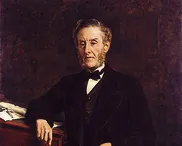
You well may not have heard of Edward Kimball. Before I tell you about him, let me tell you about D.L. Moody…
D.L. Moody was an American evangelist who is estimated to have preached the gospel to over 100 million people.
He was born in 1837 and, after the death of his father in 1841, his mother was left with seven children while pregnant with twins. She struggled with poverty and debt and Moody was often sent away to stay with other families.
As a result his schooling suffered. He attended school off and on between the ages of six and ten. When he became a preacher it was said that he pronounced the word ‘Mesapotamia’ with one syllable! At the age of 17, after his many applications for jobs in his home town were rejected, he left home in Northfield, Massachusetts and went to live in Boston where he got a job selling shoes in a shop owned by his uncle. He got the job on condition that he attended the Congregational Church where he joined the Sunday School.
Moody’s Legacy
After he came to know Christ, he began to preach, and set up a large Sunday School which was visited by President Lincoln. He joined forces with a gospel singer called Ira D. Sankey and travelled America holding large evangelistic meetings in the cities, at which many were converted. He became a household name in America and during World War 2 a ship was named after him (SS Dwight L. Moody)!
He was a hugely influential figure in American Evangelicalism and the Moody Church and the Moody Bible Institute in Chicago still flourish today.
In 1872 Moody made his first visit to the UK. He made a huge impression and congregations of many thousands flocked to hear him preach a very basic gospel message. He was supported by men like the Bonar brothers in Scotland and Charles Spurgeon in London. He had a big influence on the Brethren movement and I well remember in the Brethren assembly in which I was brought up, the ‘gospel meeting’ every Sunday evening with hymns always chosen from ‘Sankey’s Sacred Songs and Solos’. Unfortunately, what worked well in the 1870s did not seem to be as effective in the 1950/60s!
Back in America, Moody’s meetings became even more popular and when he died, it was estimated at his funeral service that he had preached on average to 40-50,000 people every week! He had also published scores of popular evangelistic books and started five schools and colleges!
Kimball’s Influence
So where does Edward Kimball come into all this? He was a business man and a Sunday School teacher at the Congregational Church in Boston which Moody’s uncle insisted on him attending. Kimball remembered later how little the young man knew and how the class had to patiently wait while Moody found the relevant passages in his Bible. He wrote: ‘I can truly say that I have seen few persons whose minds were spiritually darker than was his when he came into my Sunday School class.’
Edward Kimball was not satisfied with just teaching his class once a week. He tried to get to know each of the boys he taught on a more personal level. One day in April 1855 he determined that he was going to challenge Moody personally about where he stood in his relationship with Christ. He decided that he was going to call at the shoe shop where he worked. He was in two minds whether to call during working hours, because he did not want to embarrass the boy, but in the end he resolved that now was the time.
In his own words: ‘While I was pondering over it all, I passed the store without noticing it. Then when I found I had gone by the door, I determined to make a dash for it and have it over at once’.
He found Moody putting shoes on shelves in the back of the shop. ‘I went up to him and put my hand on his shoulder, and as I leaned over I placed my foot upon a shoe box. Then I made my plea, and I feel that it was really a very weak one. I don’t know just what words I used … I simply told him of Christ’s love for him and the love Christ wanted in return. That was all there was of it. I think he said afterward that there were tears in my eyes. It seemed that the young man was just ready for the light that then broke upon him, for there at once in the back of that shoe store in Boston the future great evangelist gave himself and his life to Christ.’
Kimball’s legacy?
Next time you’re wondering whether to continue with that youth group or Sunday School class, or to keep on teaching that seemingly unresponsive youngster, remember Edward Kimball and D.L. Moody.
Since the third Ashes Test Match, I’ve started using a phrase which some people find meaningless: ‘Every Stokes needs a Leach’. Ben Stokes will be remembered for decades for his magnificent innings that won the match (though sadly not the Ashes) for England. But at the other end was Jack Leach who managed to stay in for an hour and made one run! But if he had succumbed to the 90mph Australian bowling that would have been the end of the innings and the match. Stokes could not have done what he did without Leach! Every Stokes needs a Leach! Every Moody needs a Kimball. Every Shaftesbury needs a Maria Millis (see last month’s en). You may not be a Moody or a Shaftesbury, but you may, under God, be a Kimball or a Millis.