
A missionary, writing under the pseudonym Peter Morrison, issues a wake-up call
Genocide. The Armenians. The Jews. Rwanda. And more recently the Bosnian Muslims of Srebrenica and the Muslim Rohingya of Burma. And now many fear… the Muslim Uighurs of China – more than 1 million of whom have been imprisoned in ‘re-education’ camps.
Over the summer the President of the Board of Deputies of British Jews wrote to the Chinese Ambassador and also appealed to British MPs: ‘After the ratification of the Geneva Convention the words “never again” were a common political refrain … Some of the reports emerging from the region bring terrifying echoes of the Holocaust.’
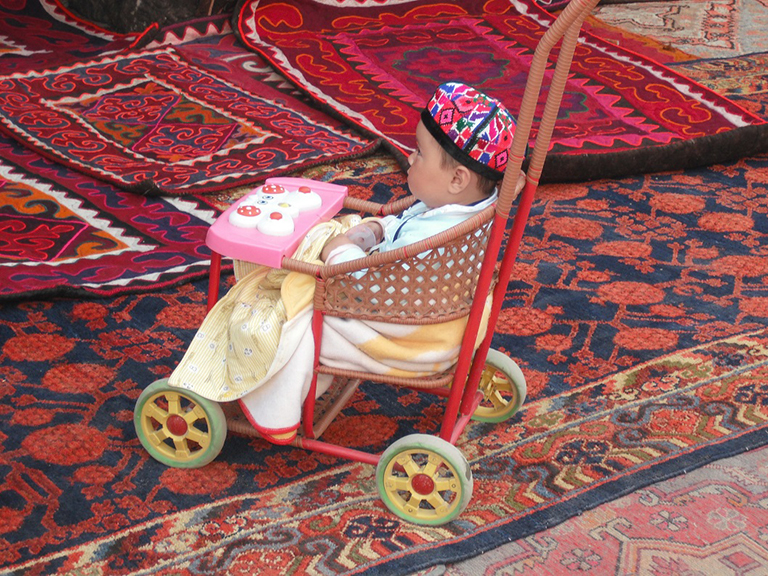
(Uighur baby in a traditional pram)
She claimed that ‘a crime of unimaginable violence’ is being committed against the Uighurs.
Later, more than 70 international religious leaders including former Archbishop of Canterbury, Rowan Williams, five Church of England bishops, a representative of the Dalai Lama, Roman Catholic cardinals, imams and rabbis issued a statement that the Uighurs are ‘facing one of the most egregious human tragedies since the Holocaust’.
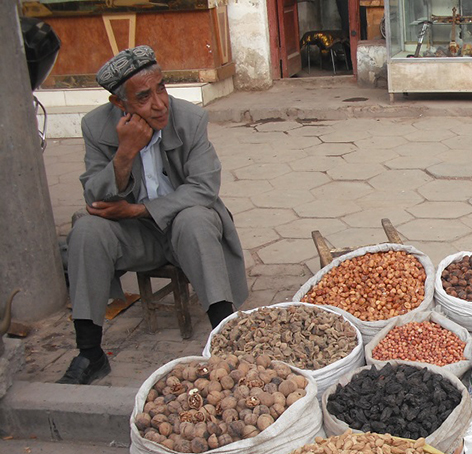
(Uighur man at his spice stall, Kashgar)
On 3 September Sir Geoffrey Nice QC, a prominent human rights lawyer, announced the setting up in London of an independent tribunal to investigate whether all the evidence of enforced sterilisation, abortion, and mass incarceration constitute genocide.
Who are the Uighurs?
The Uighurs are a Turkic people inhabiting the vast north-western region of China called Xinjiang (formerly known as Sinkiang.) The Chinese Government claims the total population is just over 12 million, but Uighur sources believe this is a deliberate underestimate and that the real figure is over 20 million.
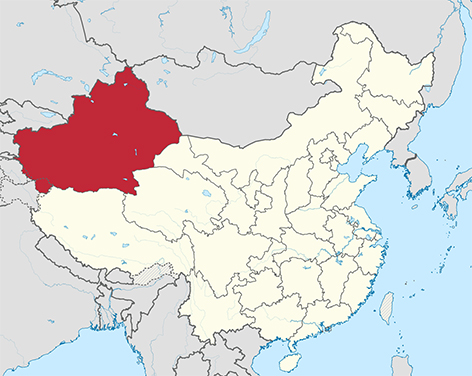
(Xinjiang, the north-western region of China)
The Uighurs may be described as ‘the Turks who stayed behind’ when many Turks crossed Central Asia and conquered what is now Turkey, but was then part of the Byzantine Empire in the 11th century AD Before that the Uighurs founded a powerful kingdom and believed in a variety of religions including Buddhism and Nestorian Christianity. However, in 934 AD the Uighurs decisively embraced Islam. It was not until 1884 that Xinjiang was officially annexed to China by the Manchu Qing dynasty and given its name, meaning ‘New Territory’. In 1949 the Chinese Communist army snuffed out the short-lived Uighur Republic of East Turkestan in a particularly brutal campaign. Over the last 70 years mass migration of Han Chinese into Xiinjiang has seen the Han Chinese population grow from only 6% to over 40% and the Uighurs are now a minority.
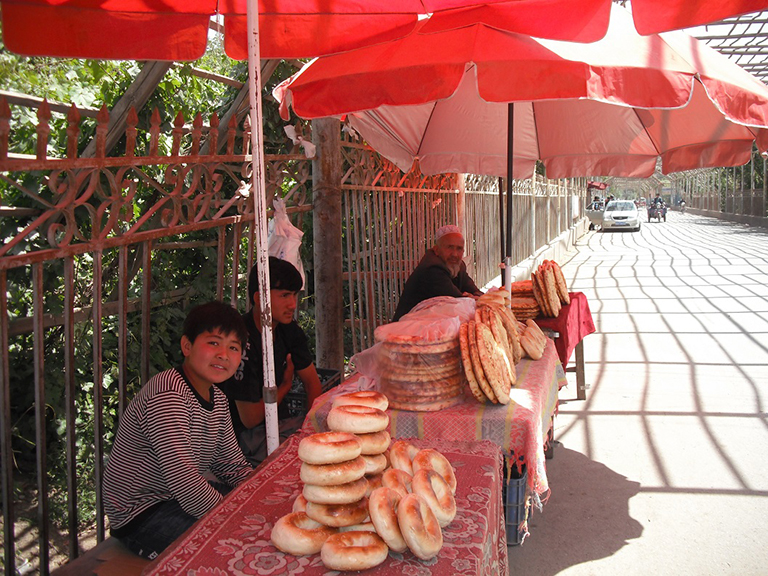
(Uighur boys selling naan bread)
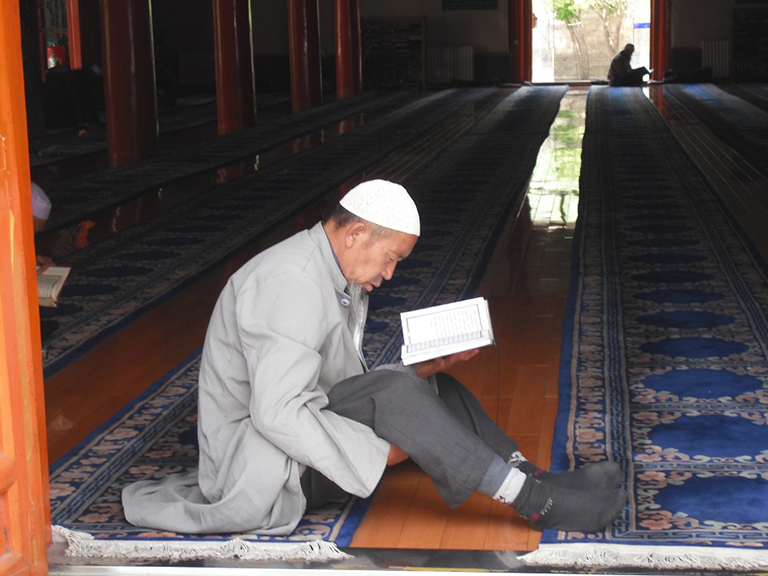
(Uighur man at the Id Kah mosque in Kashgar)
The crackdown
On several visits to Xinjiang I was told by Uighurs of their longstanding grievances, including arbitrary arrest and forced, unpaid labour, even before the present crackdown. This led to increasing ethnic tension and a number of terrorist attacks by a small minority of Uighur Muslim fundamentalists.
In April 2014 the new leader of China, Xi Jinping, visited Xinjiang just after Uighur terrorists had stabbed and killed 39 people in Kunming. According to secret documents published by the New York Times in November 2019, he called for an all-out onslaught against terrorism using the ‘organs of dictatorship’ and called for ‘absolutely no mercy’ to be shown.
In fact, the vast majority of Uighurs are peaceful farmers and shopkeepers following a relatively moderate form of Sunni Islam with some attracted to Sufi mysticism. Beijing’s increasingly draconian policies have had the effect of driving some Uighurs into the arms of Al-Qaeda-type fanatics – the very thing Beijing most fears.
In February 2017 the new extreme Chinese Communist Party boss in Xinjiang, Chen Quanguo, called for a ‘smashing, obliterating offensive’. A huge network of internment camps numbering up to 1,200 – euphemistically called ‘re-education centres’– has been set up and over 1 million ordinary Uighurs interned for long periods of brainwashing and indoctrination. They are forced to learn Mandarin and undergo daily mind-numbing Communist propaganda sessions extolling Xi Jinping. Whole villages have been emptied leaving only the elderly. Worse, many Uighur children have been shipped thousands of miles away to distant parts of China to attend schools where they are forced to shed every vestige of their Uighur upbringing and become obedient tools of the Party. If, and when, their parents finally emerge from the camps, they are unable to trace their children.
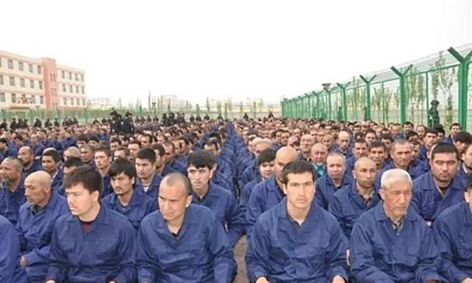
(Internment camps)
Amina, whose only ‘crime’ was studying in neighbouring Kazakhstan, said guards shackled her hands and feet and kicked her with metal-tipped boots simply for asking what crime she had committed. She was made to swear she would never again go to a mosque, wear a headscarf or pray. (Islam is one of five major religions officially recognised in China.)
Simultaneously there has been an intensive campaign to physically destroy Uighur history and culture. Satellite pictures reveal that entire Uighur traditional neighbourhoods in many cities have been bulldozed, to be replaced by typical Han Chinese apartment blocks and shops. Many mosques have been destroyed and, most shockingly, ancient Uighur cemeteries have been obliterated and turned into car-parks.
Photos have emerged of Uighur men, bound and blindfolded kneeling on station platforms waiting forcible shipment to factories in distant east China.
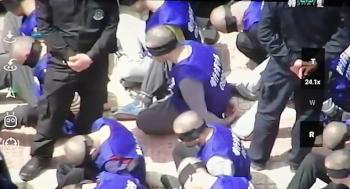
(Awaiting forced shipment to east China)
Beijing’s crimes go even further: a mass campaign of forced sterilisation has seen the population growth in the Uighur heartland of Kashgar and Khotan plummet by 84% between 2015–2018. Beijing’s draconian birth-control policy is being described as ‘creeping genocide’ or ‘demographic genocide’.
The gospel in Xinjiang
The spread of the gospel among the Uighurs has been marked by difficulties and martyrdom. In the 1930s the Swedish Mission established a church among the Uighurs of Kashgar which was one of the most successful outreaches to Muslims of all time. Sadly, a Muslim warlord massacred virtually all the converts.
In the 1940s various Chinese believers arrived in Xinjiang motivated by the ‘Back to Jerusalem‘ vision. I had the privilege of meeting one of the few surviving pioneers. She told me that the communist victory in 1949 stopped the pioneers in their tracks and several of them had also been martyred; all she could do was quietly witness to the young Uighur workers on her farm by Christian example.
The gospel has spread widely among the Han Chinese in Xinjiang – perhaps as many as 100,000 have become Christians. But I was told by the leading pastor of Urumqi’s main church that outreach to Muslims was strictly forbidden. This and the tension between Han Chinese and the Uighurs has resulted in only a tiny Uighur church – perhaps a total of 500 converts.
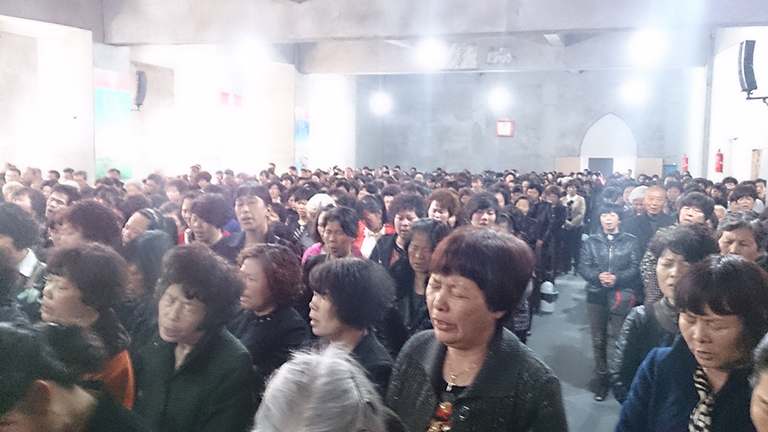
(Worshippers at the big Protestant church in Urumqi)
After the crackdown news has leaked out that about a dozen Uighur Christians have also been sent to the camps. A translation of the Bible into modern Uighur has been printed, but distribution in Xinjiang is now very dangerous. The tiny Uighur church is caught between fanatical local Islamists on the one hand, and equally extreme doctrinaire Communist Party officials on the other. Alimujiang, a Christian Uighur convert, has been in prison for many years for his faith, and he and the infant Uighur church are in need of much prayer support.
Global implications
A leading cyber-expert on China describes Xinjiang as a giant human laboratory where ‘cutting-edge Chinese tech companies can demonstrate the capacities of their artificial intelligence-driven systems to control a population’ (The Sunday Times, 14 July 2019). The degree of surveillance is chilling. An Integrated Joint Operations Platform records data from mobile phones, face-recognition cameras and barcodes on the doorways of every Uighur home. Where Uighurs go, whom they talk to, their facial expression, every behaviour is monitored. Huawei and other Chinese hi-tech giants whom the UK naively accepted at face value have been deeply involved in setting up these systems. A Han Chinese engineer who at great personal risk researched the atrocities being committed, commented; ‘In the eyes of the Chinese Government Uighurs are not considered human. They are like mice being experimented on for research purposes.’ A sympathetic Han Chinese official (by the way, hundreds have been dismissed in Xinjiang for opposing the new campaign as too extreme) was asked:’Do Uighurs feel their human rights are being violated?’ He replied:’They don’t have human rights. It’s not about violating – they just don’t have human rights.’
The world’s response
Islamic nations have largely remained silent, fearful of Beijing’s increasing global economic clout. Over 80 well-known Western brands including Nike and Adidas have been accused of using Uighur forced labour in China. Over 80,000 Uighur workers have been forcibly removed to such factories (The Daily Telegraph, 3 March 2020). Elements of Beijing’s system have been used to control Chinese Christians and Hong Kong pro-democracy demonstrators. In America both Republicans and Democrats are considering whether to apply the term ‘genocide’ to what is happening in Xinjiang and high-level moves have been made in Congress and the Senate to punish those Chinese officials involved (The Daily Telegraph, 11 September 2020).
The same British cyber-expert comments: ‘This has global implications, because what we’re seeing in Xinjiang is the early stages of a new form of governance that is controlled through advanced predictive algorithmic surveillance networks. If those systems were exported that would be a massive setback to the cause of human freedom and liberal democracy around the world.’
Freedom and democracy are largely the fruits of a Christian worldview. Will Christians, too, remain silent ?


How God used my grief to bring me closer to Him
During every trial that I've gone through, I have tangibly experienced the presence of the Lord, but none more so …