

In 1620, 102 ill-prepared settlers landed two months later than planned, in the wrong place on the eastern coast of North America.
They were a mixture of ‘saints’ (asylum-seeking members of separatist Puritan congregations) and ‘strangers’ (economic migrants necessary for the financial success of the venture). By the next summer, half of them were dead. Yet, from this inauspicious beginning, the impact of the Mayflower settlement still resonates 400 years later.
Writing Mayflower Lives (2019) I explored this venture through the lives of 14 of those who took part. Well, actually it is 15, as Priscilla Mullins and John Alden are a double act. Their faith and courage continue to inspire, for all our cultural difference, as does their ability to create a community from both ‘saints’ and ‘strangers’. And, in contrast to what came after, they generally had constructive relationships with Native Americans. For all these reasons they repay study and remembering. This is a brief introduction to these ‘Mayflower Lives’.
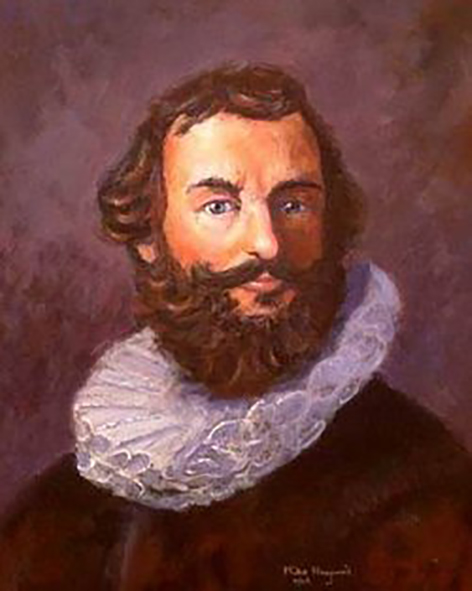
Christopher Jones (above): Master of Mayflower. Christopher is famous as the sea captain who, as far as we know, had never before sailed to North America. Based at Harwich, and then Rotherhithe on the Thames, he and his ship became part of the venture because those backing it (London merchant adventurers) were looking for a low price. After a tough crossing in the face of rising seas, and a winter spent moored off the Massachusetts coast while disease ravaged the settlers and sailors, he sailed back to England in 1621 only to die in 1622, aged about 52. Mayflower was broken up in 1624, having been described as being ‘in ruins’, and having been laid up since the voyage of 1620-21.
William Bradford: a ‘saint’ fleeing ‘Babylon’. William came from Austerfield, South Yorkshire. By 1597 he was an orphan and ended up living with his two uncles. There he fell seriously ill and, over the course of months confined to his room, underwent a profound conversion. This left him dissatisfied with the spirituality of the Church of England. As a result, he joined an illegal separatist congregation at nearby Scrooby, and eventually emigrated with it to the Netherlands in search of religious freedom. He became a leading member of the fellowship and in the decision to move to the New World. Like his companions he hoped to build a ‘New Jerusalem’ of godliness there. From 1621, to his death in 1657, he was frequently elected governor of the little colony. His compilation, entitled Of Plimoth Plantation, is a key source of information for the settlement.
Susanna White: mother of the first European baby born in New England. Susanna was one of the ‘saints’, and was pregnant when she boarded Mayflower, in the company of her husband, William, and their son Resolved (a classic ‘godly’ name). She was one of three pregnant women to endure the terrible weeks of the sea crossing. Susanna gave birth to a son, who was named Peregrine (‘pilgrim’), late in November 1620, while Mayflower was anchored in the shelter of Cape Cod. He was the first European born in New England. Her husband died that first winter and she married Edward Winslow, a leader among the separatists.
Stephen Hopkins: survivor of shipwreck, with unique New World experience. Stephen was a ‘stranger’. Alone among the passengers he had experience of the New World, having been shipwrecked on Bermuda in 1609 (an event giving rise to Shakespeare’s play ‘The Tempest’). In a homemade boat he reached Jamestown in Virginia – the earliest surviving English colony in America, founded in 1607 – and eventually back to England. Consequently, in 1620, he brought valuable experience to the Mayflower venture and took part in the exploration which led to the selection of the settlement site at ‘New Plymouth’.
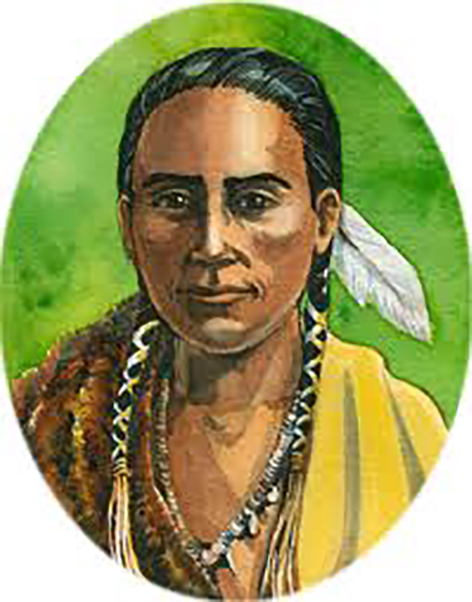
Tisquantum (Squanto) (above): Native American ‘survivor’. Squanto was seized by English slave traders; sold in Spain; freed and lived in London(!); then returned to ‘New England’ with an English expedition in 1619, to find that his tribe had been wiped out by diseases introduced by European fishermen. When Mayflower arrived he acted as an English-speaking intermediary between other Native Americans and the newcomers. He played a vital part in helping the newcomers survive by teaching them native farming skills.
Mary Chilton: (reputedly) the first to step onto ‘Plymouth Rock’. Mary, another ‘saint’, was allegedly the first ashore on ‘Plymouth Rock’, when Mayflower finally moored there in December 1620. However, there is no mention of the famous ‘rock’ in any contemporary records and it is not mentioned as the landing place until 1741. Despite this, her leap from boat to ‘rock’ has become the stuff of Mayflower legend.
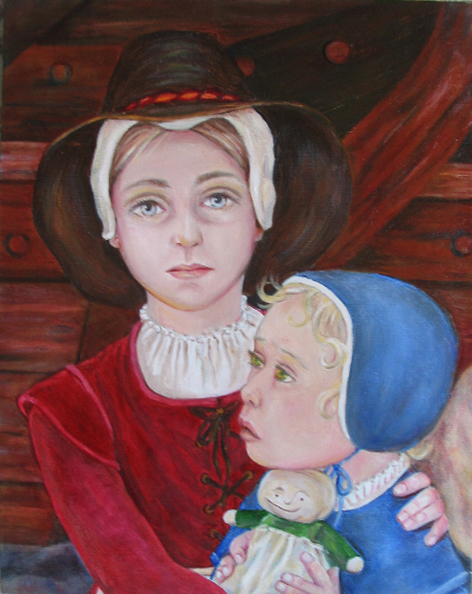
Mary More (above right): unwanted four-year-old. Little Mary truly was a ‘stranger’. She was one of the four ‘More children’ travelling without any family. Their father believed them (with reason) the children of an adulterous relationship his wife had with a neighbour. To dispose of them, he sent them to North America as servants. Their mother fought a desperate legal battle to get them back. She failed and three of the little children died in the first terrible winter of 1620-21. She never saw them again. A tragedy.
John Howland: man-overboard, negotiator, and fur trapper. A servant of one of the leading ‘saints’, John fell overboard on the stormy crossing, grabbed a trailing rope and survived! In the colony he became a leading member, helped it clear its debts to its backers in London, and helped develop the lucrative trade in beaver fur. He was present on the Kennebec River, in 1634, in a famous altercation with rival English trappers from newly founded Boston, which resulted in two deaths.
William Brewster: diplomat and preacher. One of the leading ‘saints’, William was the only Mayflower Pilgrim who had political and diplomatic experience in England; and he was the only university-educated member (from Cambridge) in the early colony. The colony struggled to find a suitable minister to care for their spiritual needs in the New World. As a result, Elder Brewster acted as preacher and spiritual guide for many years. He was greatly respected.
Edward Winslow: Pilgrim leader, colony agent and ‘lobbyist’. Edward was a leading ‘saint’ who acted as a pamphleteer, promoting the colony and the opportunities provided by North America. He developed good relations with Native Americans. He was also politically active and, from 1646, was back in England. In 1655 he was sent by Cromwell to help supervise the English military expedition against the Spanish colonies in the West Indies. It was while on this mission that Edward died of yellow fever.
Captain Myles Standish: commander of the Plymouth Colony militia. Myles was a ‘stranger’ who was the military commander of the colony. Short of stature, one of his enemies called him ‘Captain Shrimp’. But he was an experienced soldier and not above taking pre-emptive action if he felt the colony was in danger. This was shockingly seen at Wessagusset, in 1623, when he ambushed and killed members of a tribe he believed threatened the colony. The head of the dead Native American leader was placed over the gate at ‘New Plymouth’ as a warning.
Priscilla Mullins and John Alden: famous lovers. John was a ‘stranger’ who joined the ‘saints’ when he married Priscilla. Subjects of a famous poem by Longfellow in 1858, these two remind us of the reality of romantic love among the godly. The Puritans took the idea of pleasurable sex within marriage seriously and did not denigrate it.
John Billington: straying from the ‘narrow way’. John and his family remind us of the problems inherent in building the ‘New Jerusalem’. John was punished for insubordination and dissension. In 1630 he was hanged for murder.
Richard More: New World sea captain. Richard was the only one of the four ‘More children’ to survive, and went on to become a New England sea captain and was involved in military campaigns against the Dutch and the French. He also fought in King Philip’s War (probably the most lethal war ever fought between colonists and Native Americans) in the 1670s. It was the end of a period of generally peaceful relations. He died at Salem, as the infamous witch hunts were taking place. Incidentally, nobody was ever executed as a witch further south in Plymouth Colony.


Are the US-Israel strikes on Iran a 'just war'?
Christian Just War theory represents one of the most influential ethical traditions for evaluating the moral legitimacy of warfare.Developed …