What is the gospel? That sounds like a pretty basic question that every Christian knows the answer to. But wait, what are your ‘go-to’ Bible verses if you were asked to sum up the key elements of the gospel? Take a minute to jot them down – we will return to them later.
The gospel, like the spectrum seen in a quality diamond, radiates an exquisite array of themes. Each of the four Gospels, for example, has its own unique emphasis on the person and work of Jesus: Matthew (Jesus as King), Mark (Jesus as Servant), Luke (Jesus as Man) and John (Jesus as God). They also record how our Saviour brought the good news to a kaleidoscope of cultures, classes, religious standings, genders and ages. But how much should this variety in the starting point of the hearer determine the nature of the gospel message presented to them?
This is a pressing question, especially given the growing ineffectiveness of much Western Christian mission. It is suggested that the three basic cultural mindsets – guilt-innocence (Western), shame-honour (Eastern) and fear-power (Southern) worldviews – proposed by applied anthropology may help us. From here a strand of teaching has gained traction with several missionary agencies; that the truly humble missionary must listen to the cultural questions being asked and present the gospel within these cultural frameworks1-3 – the gospel must be contextualised.
What might a contextualised ‘gospel’ sound like? In an Eastern culture where honour is prized above innocence, and shame is abhored more than guilt, the honourable Jesus was shamed on the cross to take away our shame, restoring man’s honour and saving God’s face4. Similarly, in a Southern (animistic) culture dominated by fear of evil spirits or diabolical dictators, Jesus defeated principalities and powers, empowering us to live in freedom from oppressive fears5.
While there is some truth here, this ‘three-dimensional’ approach6 implies that Western missionaries have failed because they have presented a Western gospel in an Eastern or Southern culture. They have failed to contextualise their message.
But this raises one obvious question: Why stop at these cultural subdivisions? In the shifting sands of the 21st century, why not adapt the gospel to the values of every subset of humanity? Is there an eco-warrior gospel, or a petrolheads’ gospel? Are there socialist and capitalist gospels? Are there black and white gospels? Are there gay and straight gospels? Are there woke or hip-hop gospels? With this dizzying array of potential ‘gospels’, we need to reiterate: What is the gospel?
Let’s return to your ‘go-to’ Bible verses. There are many to choose from. In the table, there are some popular ones (though you might have selected others) and the key theological concepts they contain.
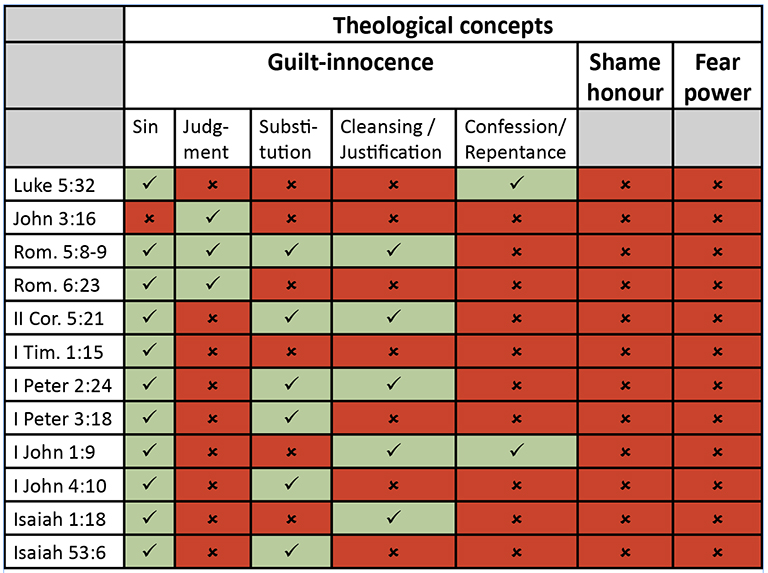
Other concepts include: Reconciliation (1 Peter 3:18); Salvation (John 3:16, 1 Tim.1:15); Faith (John 3:16); Eternal life/ heaven (Luke 9:32, John 3:16, Rom. 6:23)
While no verse covers everything, the total absence of unambiguous shame-honour or fear-power concepts is illuminating! There are two possible interpretations. Either we are drawn to verses that reflect our Western guilt-innocence cultural blinkers, or the Bible does not present a shame-honour or fear-power ‘gospel’.
Notice that our verses seek to explain the work of Christ on the cross. While Jesus did carry our griefs and sorrows (Isa. 53:3) and deliver us from the fear of death (Heb. 2:15), these symptoms are being remedied by dealing with the underlying cause. The central element of the gospel is that God was ‘making his soul an offering for sin’ (Isa. 53:10). Atonement was being made. God was being propitiated. When we refocus on this key element, the contextualised shame and fear ‘gospels’ emerge as sticking plasters and painkillers – numbing the symptoms of a much more deadly condition (sin). Tragically, in some more nuanced contextualisations, for example in an eco-warrior ‘gospel’ (where an eco-warrior ‘Christ’ came to restore the earth to its former glories), the cross of Jesus serves no discernible purpose.
Despite such ‘technicalities’, these relatively recent contextualising innovations sound highly plausible, especially when it is suggested that not to contextualise the gospel reveals that you are not walking with Jesus7, but displaying an arrogance that most likely arises from a Western colonialist superiority complex8. Is this then another example of a politically-correct, philosophical mumbo-jumbo that makes the cross of Christ of none effect (I Cor. 1:17)?
No, it is much worse than that.
If you want to understand the gospel and its implications, you cannot avoid Paul’s Epistle to the Galatians. In Global Humility, Andy McCullough poses the question: ‘How come Paul is so angry in Galatians? What is the sin of the Men from James?’ His answer is: ‘The sin of the Men from James was that they believed they could impose, or at least commend, Jerusalem Christianity (later defined as “Torah-keeping, and circumcision and dietary constraints”, and “other Jewish cultural baggage”) to non-Jerusalem Christians. They had not understood that all expressions of Christianity are contextual, including their own.’8 This clever approach implies that the Men from James had failed to grasp that their circumcision Christianity was not aligned with Galatian cultural norms, and therefore Paul reacted angrily to their failed contextualisation. Thus, we must accept contextualisation or face the wrath of Paul. Does this make sound exegetical sense?
You don’t need to be a systematic theology professor to work this out. If the message coming up from Jerusalem was inappropriately contextualised, then it must have been a legitimate gospel for the church in Jerusalem – they needed circumcision (and ‘other Jewish cultural baggage’) to be saved. It is obvious from reading Galatians that such an interpretation doesn’t hold water. Paul calls the message from Jerusalem ‘another gospel’ (1:6), ‘not a real gospel’ (1:7) and ‘a perversion of the gospel’ (1:7). While dismissing it as a non-gospel (bad news) he refers to those peddling it as ‘false brethren’ (2:4) who were disguising their true character (2:13). This was manifestly not a failure of contextualisation.
Abusing Scripture is bad enough but legitimising the message from Jerusalem is dangerously erroneous. Peter made it crystal clear at the first council of Jerusalem (Acts 15:1-35), that Jews are saved by grace through faith without circumcision, just like Gentiles (Acts 15:11). There is one gospel for both sides of this ancient cultural division (read Romans chapters 2-5). We need to recover our confidence in the one everlasting gospel for all peoples (Rev. 14:6), and that this one gospel came from God (Gal. 1:11-12) – i.e. was not the product of human culture – and is to be accepted by all (1 Tim. 1:15). But the proponents of contextualisation claim that their multiple contextualised gospels are different faces of the same diamond. However, when this results in legitimising bad news as a form of the good news, something has gone profoundly wrong with our logic, let alone our theology.
So, where does this leave us?
While understanding cultural frameworks may be helpful in initiating a gospel conversation, we must avoid promoting the symptoms of man’s condition (shame and fear) to the level of cause (sin and rebellion against God). While we may start with what our hearers understand, we must end up with the Bible’s diagnosis and remedy. Every ambassador for Christ is charged with presenting God’s verdict and God’s remedy.
To summarise, the contextualised ‘gospel’ is a sophistry that misrepresents the symptoms as the cause, redefining the substance of the gospel. It is not the good news of the Bible, but another highly plausible, cleverly fabricated heresy, robbing Christ’s ambassadors of the message they are sent to convey. Such deviation from the divinely-inspired gospel brings from Paul his strongest, Spirit-inspired words: ‘But though we [one of the apostles], or an angel from heaven [we need to get that], preach any other gospel to you than that which we have preached unto you, let him be damned’ (Gal. 1:8). Is that too strong for delicate ears? Listen to the next verse. ‘As we said before, so say I now again: If any man preach any other gospel to you than that ye have received, let him be damned’ (Gal. 1:9). This should make us all shudder. We need to think very carefully about the gospel we are presenting and repent if necessary – eternity is at stake.
Dr Tim Wells* is a lay preacher and Senior Lecturer in Neuroendocrinology, Cardiff University. Lois H.M. Wells is a former Reach Trainee, Friends International *Author for Correspondence (wellst@cardiff.ac.uk)
REFERENCES
1. Contagious Mission, OMF International UK
2. International Mission Board of the Southern Baptists: https://www.imb.org/2018/02/21/ engaging-major-worldviews-evangelism/
3. Insight (10th anniversary edition), Friends International Ministries UK
4. Wu J. 2012. Saving God’s Face: A Chinese con-textualization of salvation through honor and shame. WCIU Press, Pasadena CA, USA.
5. Morrison JE. 2019. ‘Contextualizing the gospel in the fear-power world of folk Buddhists.’ International Journal of Frontier Missiology 36:69-75.
6. Georges J. 2017. The 3D Gospel: Ministry in guilt, shame, and fear cultures. Timē Press.
7. Rawson K. 2015. Crossing cultures with Jesus: Sharing good news with sensitivity and grace. Inter-Varsity Press, Downers Grove IL, USA.
8. McCullough A. 2018. ‘The Men from James.’ In: Global Humility: Attitudes for mission. Malcolm Down Publishing, UK. pp35-43.