
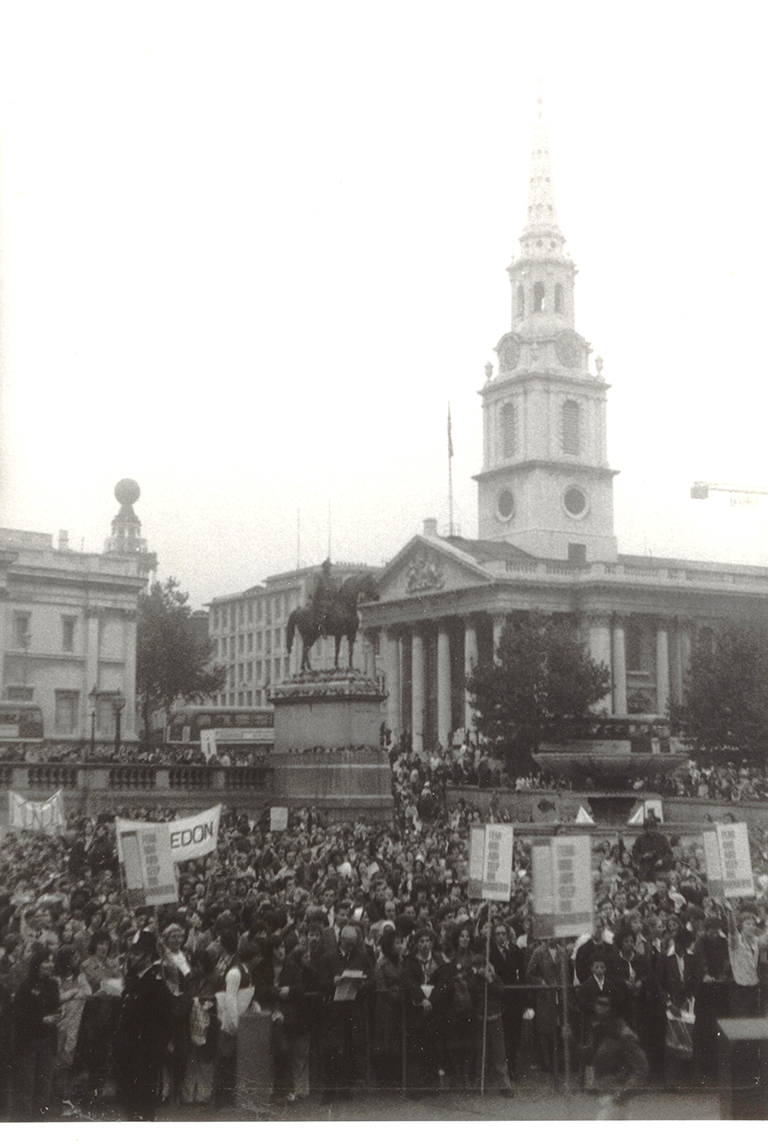
It was Saturday, 25 September 1971. Tens of thousands of people, young and old, met together on London’s Trafalgar Square for the largest ever open-air gathering of Christians in British history.
People carried placards showing a map of the UK or showing messages like ‘Jesus loves you’. Some wore Nationwide Festival of Light (NFoL) T-shirts and there was a general atmosphere of sheer excitement and expectation.
In the Square, a great platform and stage hosted The Revd Eddie Stride, joined by Malcolm Muggeridge, Lord Longford, Mary Whitehouse (see photo below), and a Salvation Army Band. They all stood underneath a banner saying ‘Moral Pollution Needs a Solution’. The Square was so full that the police had to divert people to wait in Hyde Park.
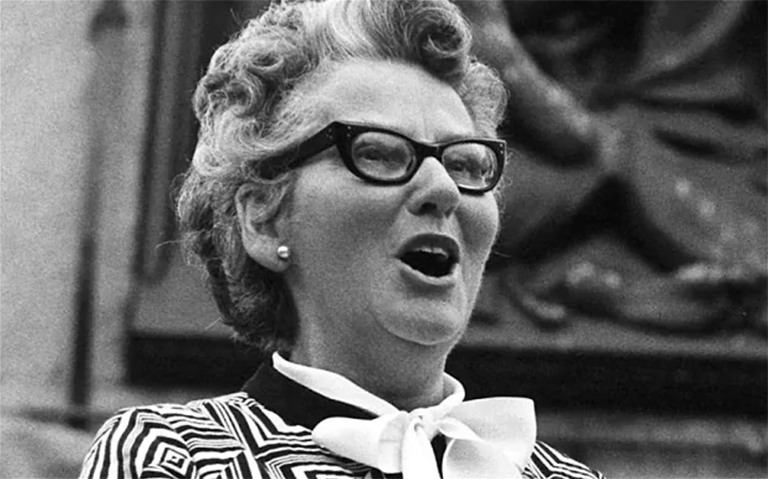
One woman who was there, Margaret, said: ‘On the Tube, thousands were singing. Everywhere, Christians proclaiming Jesus. At Trafalgar Square, we all joined in praying for our nation and praising God. Coming from a tiny village, I’d never seen so many Christians before! None of us wanted the day to end!’
Another woman, Jane, remembers getting up at the crack of dawn to head down to London: ‘At five in the morning my church youth club was at the station, ready to board the train hired by churches in Plymouth to take people of all ages to the Festival of Light.’
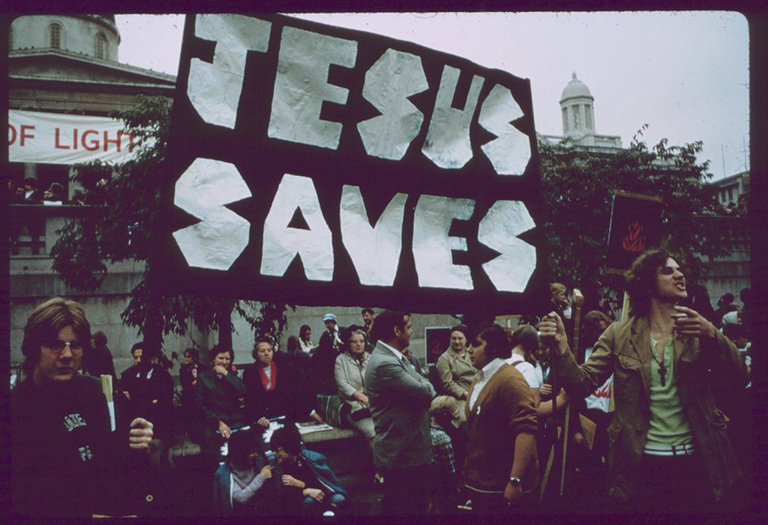
Mike, meanwhile, recalled the sense of expectation: ‘One of the elders drove 30 of us in the old Bedford bus. There was a large crowd in Trafalgar Square singing and waving placards. I had a strong impression that what we experienced was a move of God and a strong witness against the prevailing secular culture.’
Nights before 25 September, bonfires blazed over hilltops right across the nation. An estimated 100,000 Christians at 300 sites were involved in creating this ‘ring of fire’. In Somerset, a youth group lit a beacon and, in Sheffield, Cliff Richard did the same during the interval in a concert he was giving.
One person who was in Hyde Park marks his conversion to Christ on that very day: ‘I was sitting under a very large oak tree in Hyde Park when I heard about the cross and the forgiveness God offered to those who follow Him. It was beneath that tree I gave my life to Jesus. It [my life] was never the same again.’
It all had its origins less than a year before, when Peter and Janet Hill returned from years of missionary service. They were dismayed to see the deterioration in public attitudes to sexual morality. Praying, they felt God leading them to reach out to others and seek to mobilise the church to speak out. The NFoL gathered support from Anglicans, Baptists, Methodists, Pentecostal churches – to name but a few – as many caught the vision.
Once the speeches in the square were over, the large crowd went to Hyde Park, singing as they went. Cliff Richard, Dana, Graham Kendrick, Larry Norman and others performed. The aim was to galvanise the church to speak the gospel into society and to take a stand for God’s ways and wisdom for all human flourishing.
What made the festival so historic was that it came after a season of apathy within the evangelical church, especially about public morality. In the 1950s and 1960s laws were repealed, and new ones passed, which represented a fundamental shift in the culture away from a Judeo-Christian heritage and towards a more promiscuous and liberal society. Of course, not all the changes of the 50s and 60s were negative. But with divorce made easier and abortion legalised in 1967, core values were rapidly changing.
While all this was going on, some sensed that the church was largely not engaged. The historian Callum Brown put it like this: ‘The 1960s … witnessed a frenzy of legislation that effectively de-Christianised and liberalised British law and society. In a mood of depression, and assailed by liberals within who argued for change, the forces of church reaction largely fell silent during the nation’s greatest moral and cultural revolution.’
The NFoL sought to challenge this silence and encourage the church to speak out and, following the gathering in Trafalgar Square, a series of four events were planned. First, there was Mary Whitehouse’s petition for Public Decency which collected 1.5million signatories. Then there was Operation Newsagent, a campaign encouraging people to contact shops to urge them not to sell ‘materials that cheapen and devalue dignity’. Then there was a nationwide Outreach on the Streets movement and, finally, a five-day-long Festival for Jesus in the late summer of 1972.
Around this time The Revd Lyndon Bowring, one-time Associate Minister at Kensington Temple, was getting more involved and became the NFoL’s Chairman on 26 September 1981. At the same time, the NFoL was also being encouraged to take up new issues, like abortion, and play its part in influencing politicians to have a deeper respect for the value of life. In 1983, the NFoL changed its name to CARE, which stands for Christian Action Research and Education. The aim was to focus more intensely on influencing parliamentarians and legislation, while also equipping churches and encouraging practical, caring initiatives.
CARE began life in the basement of a Mayfair vicarage. Despite its smelly drains and the mushrooms that grew under the carpets, its location and God’s grace allowed the work to flourish. By the end of the 1980s, more than 70,000 people were receiving regular information from CARE. In 1988, God provided an office space at 51 and 53 Romney Street, just a few minutes from the Parliament at Westminster, to accommodate the growing team.
Over the following years, CARE’s work expanded into Northern Ireland, Scotland, and Europe and the United Nations. Its portfolio included Care for the Family, headed up by Rob Parsons, and Care for Education, and in 1993, Care for Life was also set up which in time would support and co-ordinate more than 160 Christian-run crisis pregnancy centres across the UK. Also in 1993, the Leadership Programme began, which to this day recruits graduates, providing them with a Parliamentary placement and intensive theological study to equip them to be faithful witnesses in politics and other fields.
In more recent times, CARE has focused more intentionally on working with Parliamentarians across the UK, helping to influence laws and legislation, while continuing to invest in new leaders through the Leadership Programme and supporting practical, caring ministries like OPEN, the post-abortion healing ministry. In God’s goodness, there’s been success: especially in relation to protecting people from gambling-related harms and seeing anti-human trafficking laws passed in every part of the United Kingdom. CARE has also been heavily involved in campaigns to stop the legalisation of assisted suicide, and producing annual reports that helped persuade the Coalition Government to reintroduce a marriage tax break. At the same time, there has also been times of deep sadness, especially in relation to increasingly liberal abortion laws and fresh attempts to police freedom of speech.
As we look to the future the need for a faithful, Christian influence in the corridors of power is just as great as when the ministry began. The challenge is to remain faithful, while also seeing God’s continued wisdom over what causes to take up and which ones to leave to others.
James Mildred
James is the Chief Communications Officer for CARE
Looking ahead:
CARE’s incoming CEO writes:
‘I’m worried about immigration’, an elderly woman exclaimed to me in very animated terms when I asked about her greatest concern and what was likely to impact the way she would vote in the upcoming 2005 General Election. I was canvassing the area as part of the election campaign, and our team knew that she had lived all her life in the same Welsh village of Cwmffrwd, about 30 miles northwest of Swansea.
‘Do you have many “immigrants” in the village?” I asked, before adding ‘and where are they from?’ I readied myself for a conversation about the differences between economic migration and asylum.
‘Oh yes’, she replied. ‘There’s a family moved in opposite the post office. They’re from Bridgend.’
It was an early lesson on the importance of perspective and listening to others when it comes to being a follower of Jesus in the public square.
In 1983 CARE (Christian Action Research and Education) was formed out of the Nationwide Festival of Light whose 50th anniversary James Mildred writes about above. Over the past 40 years, CARE has been a faithful presence in the corridors of political power and a witness and prophet to the church on key issues. Alongside this, CARE has also discipled a new generation of leaders through the Leadership Programme. It has been a bulwark against harmful legislation, the catalyst for promoting good laws that have protected the vulnerable, and the means by which Parliamentarians have heard God’s word spoken into some of the key issues of the day with truth and grace.
This Autumn I will have the privilege of stewarding the next season in CARE’s story as I take over from Nola Leach as Chief Executive. I will be stepping into big shoes, standing on the shoulders of heroes of the faith.
The Revd Lyndon Bowring, CARE’s co-founder, and Chairman, who, with his wife Celia, have poured their lives into the mission of being salt and light in the public square, recently told me a striking story. Back in the 1970s, in the House of Commons, Lyndon was standing next to Lady Tony Lothian, who he described as an outspoken and courageous journalist. She leaned over to Lyndon and whispered ‘Lyndon, lights went out in this House in the 1960s and 70s that may never be relit’.
The story reminded me of the extraordinary fact that a human eye can see a single candle flame in the darkness from over a mile and a half away. Often, we Christians can feel like that candle flame – a small, flickering light, likely to be overwhelmed by the darkness. Whether it’s identity politics, debates about gender, eroding the sanctity of when life starts and ends, violence, exploitation, inequality towards different groups, or the challenges of new technology from social media to Artificial Intelligence – all this can feel like an unstoppable attack on the Christian ethic, and God’s common grace.
We are prone to feel so worried and concerned by all this, we can be tempted to protect the light of truth by putting it under a bowl where it will be safe.
But that is exactly what Jesus warns us against (Matt.5:14). Indeed, recalling my science lessons at school, putting a candle under a bowl does the very opposite of protecting the flame; it starves it of oxygen and the light is extinguished. Whereas, with God’s grace, a single flame can pierce the most overwhelming darkness.
Over generations CARE, with others, ensured that the light in Parliament was not completely extinguished. We have kept that flame alive, and just as the Nationwide Festival of Light began 50 years ago with beacons being lit across the country, it is my prayer that we will ignite the flame afresh in a new generation who love and sit under the lordship of King Jesus.
As we contemplate this great task, there are reasons for hope! For the past 15 years I have worked with and spoken to thousands of children, young people, and young adults. I can say unequivocally that they are more interested in understanding what it means to uphold the dignity of every person, more engaged in social and ethical issues, and hungrier for truth than I or my friends ever were when we were teens or young adults.
Our challenge is to reach them and share with them the gospel of a better story than the world has to offer. Of course, in reaching out to inspire new generations we must be careful not to concede the truth on which we stand. Millennials and Gen Zs may well support issues above organisations and be campaigners more than givers. Understanding this is not the challenge. It is to open their eyes to the dangers of the worldview that lies behind the presenting issues of our day.
If we yield the foundations of objective truth and justice to subjectivity and relativism, we undermine the power of God’s word. If all we want is to beat our opponents, we can lose sight of grace and a redemptive relationship in Jesus. If all we are about is winning the fight issue by issue, we devalue standards of civility in public life, the importance of character and call to faithfulness.
We are people of the big picture and the fine detail. We have the right perspective and a better story to tell. We can and should have great confidence in the power of truth and in the wisdom of God’s perspective on any and every cause we take up.
CARE will continue to be a faithful presence in the public square and present Biblical truth to the key public policy issues of our day with the confidence of our gospel hope. I believe the need for CARE’s mission has never been as great; the time to be the catalyst for renewal never more essential. We must listen to the cries and impulses of the current age, while also listening carefully to God’s word.
We thank God for 50 years of provision, generosity, and faithfulness. It spurs us on to defend the dignity of every person as image bearers, for God has placed us here for such a time as this.
Ross Hendry
Ross Hendry, incoming Chief Executive of Christian Action Research and Education (CARE). Ross is currently CEO of Spurgeons and is due to start with CARE in the Autumn. He replaces Nola Leach, who is retiring and who’s been CEO of CARE for the past 17 years.