
Back in 2014, Sir John Houghton (1931 – 2020) agreed to be interviewed by John Emyr. That interview was translated into Welsh and appeared in the Welsh-language magazine Cristion. It now appears for the first time in English.
JE: Thank you for agreeing to be interviewed. When, and under what circumstances, did you first acquire a personal faith in Jesus Christ as Saviour and Lord?
JH: I cannot give a date when I acquired a personal faith in Jesus Christ as Saviour and Lord. I was brought up in a strongly Christian home and was taught from an early age to pray and to read the Bible. In 1948 I went to Oxford University when I was only 16 and was surrounded by many older students who had been in the war. Some of these who were Christians befriended me and introduced me to the OICCU, the University Christian Union. To join the OICCU I had to declare my personal faith in Jesus as Saviour and Lord, which I was glad to do, but I also realised it was the first time I had openly declared it.
JE: What would you say to someone who finds it difficult to believe the Christian gospel?
JH: If they were people who thought that science held all the answers, I would ask whether they could understand and explain their mind, what it actually is and where it came from? It enables them to relate to other humans with minds. Christians believe also that God wants to relate to us and to express His love for us – and much more besides – through our minds.
JE: What main reasons do you offer for the claim that science and Christianity can complement rather than oppose each other.
JH: Science endeavours to describe how the universe and every thing in it works, and sets up natural laws to that end. But science on its own cannot say anything about where the descriptions originate or where the laws of nature come from. The scientific story cries out for a Creator! Christianity describes God as the Creator of all things, including everything that science describes. So they are mutually supporting; exploring how they fit together is an exciting and rewarding activity.
JE: Who are the Christian leaders who have influenced you most?
JH: I became involved with the Research Scientists Christian Fellowship during my period of graduate studies at Oxford and took part in some of their outreach events. Oliver Barclay, the leader of the Inter-Varsity Fellowship, himself a scientist, was a strong influence in encouraging scientists who were Christians to think deeply about how science and faith related to each other. Robert Boyd (later Sir Robert) was a leading scientist and also a leading Christian and helped me a lot during those early years in my career. I also got to know John Stott and benefited from his addresses, his books and his influence. In the early 1980s he asked me to give a series of talks on science and faith at All Souls Church, and preparing those talks helped me a lot in the writing of my first book on science and faith, Does God Play Dice? He wrote me a thank-you letter after the series of talks and said that all the participants had much enjoyed my scientific presentations, but that some had commented that they thought my theology needed some attention!
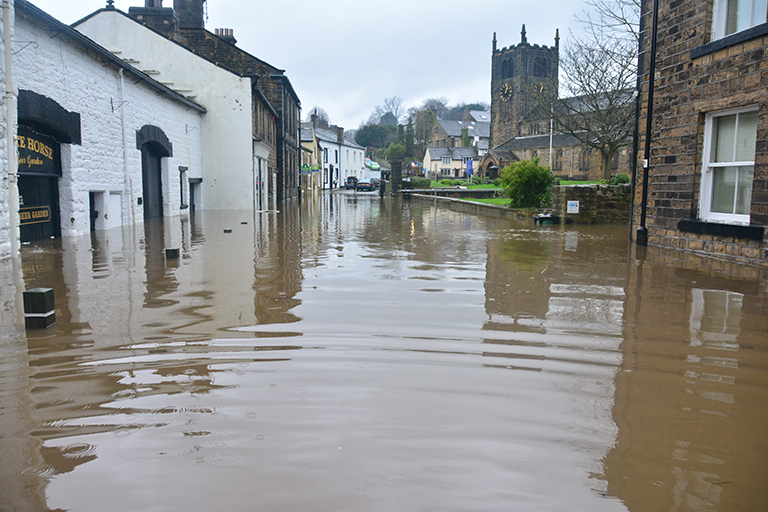
(Bingley Boxing Day floods 2015 | photo: Chris Gallagher on Unsplash)
JE: As a scientist who has made a pioneering contribution to our understanding of global warming, could you please summarise the most important aspects of this phenomenon and its possible consequences?
JH: Global warming due to human activity began to occur with the industrial revolution 200 years ago because of the use of fossil fuels, first coal, then oil, then gas, which, as they burn, emit large quantities of the gas carbon dioxide into the atmosphere. Carbon dioxide is a key atmospheric constituent; it absorbs radiation emitted by the earth’s surface, and acts like a blanket over the earth, keeping the atmosphere warmer that it would otherwise be. Its concentration in the atmosphere had been substantially constant for millions of years but, due to human activity, has now risen by over 50% so that the ‘blanket’ has become thicker and the earth’s surface warmer. As a result of this increased heat, more water vapour has been evaporated from the oceans leading to an increase in average rainfall. As the extra water vapour condenses to form clouds, latent heat is released. This latent heat is the largest source of energy for the atmosphere’s circulation which has therefore become more energetic leading to more extreme weather – heat waves, floods and droughts. These will continue to become most apparent in tropical countries, in many of which there is little resilience to cope with such extreme changes in climate.
Further, as the ocean warms and glaciers begin to melt, sea level globally has begun to rise by an amount that is expected to be up to one metre by 2100. This will be difficult enough for many living by the sea in the UK. But, in many of the world’s poorer countries, hundreds of millions will be severely affected as the sea level rises and the climate changes. To give just one example, in Bangladesh over 10million people live below the one metre contour, and it is anticipated that within a century tens of millions in Bangladesh will be forced to move and will become refugees.
A big problem with getting across the seriousness of the message is the fact that much bigger climate change has already been built into the climate system than we have yet experienced. This is because, even though over 90% of the extra energy entering the climate system due to the warming process I have mentioned is taken up by the oceans, because of their large thermal capacity (at least 100 times greater than that of the atmosphere) the warming of the oceans will take many centuries to complete. This means that, even if we stopped tomorrow all extra emissions of carbon dioxide entering the atmosphere, the climate system would continue to warm and to change for centuries into the future. We would not be able to reverse the warming process, and to ‘wait and see’ as some suggest would be a disastrous response – essentially putting one’s head in the sand.
JE: How important is it that we should all endeavour to be responsible stewards of our physical environment?
JH: With a still rapidly rising world population making growing demands on nature’s resources, it is imperative that not only the leaders of the world’s nations but everybody in the world recognises their responsibility to be responsible stewards of the creation that God has provided and told us to care for. Increasingly important is the need for all to recognise the damage to the environment that is already occurring through which we are not only cheating our children, but also increasingly cheating our grandchildren and generations to come – not to mention increasingly cheating natural ecosystems, for instance through large-scale losses of species unable to adapt to the changing climate.
JE: Would you agree that both public bodies and individuals should shoulder responsibility for the environment? As we consider our various roles, what should be our main priorities at present? How should we heat our homes and endeavour to reduce our carbon footprint?
JH: I agree strongly that all bodies with responsibility and influence, and indeed all individuals too, should see the need for doing all they can to reduce our carbon footprint (i.e. our use and dependence on fossil fuels). The fossil-fuel lobbies work hard to encourage those who oppose possible solutions or change of any kind.
The highest priority everywhere is for us all to recognise that we should become more efficient in our use of energy and to minimise its use when it is provided by fossil fuels. The UK Government has some good targets towards these ends, but could easily do a lot more. Sweden and Norway, for instance, are working towards zero carbon emissions by the year 2050. All of us as individuals also need to minimise our carbon footprint, for instance by ensuring that our homes are very well insulated and heated efficiently – for instance, by ground or air source heat pumps or by installing solar panels – and also that we drive an efficient car (e.g. an electric one) and think hard before we travel by air.
JE: Some people hold the view that we should use many more wind turbines on a significant scale. Others are concerned about their possible detrimental impact from a political, economic and environmental perspective. How would you reconcile the tension between these different points-of-view?
JH: There are many different possibilities regarding the changes that need to be made by governments to provide carbon-free energy. One is to remove the carbon dioxide from the effluent from coal-fired power stations and bury it in the ground. Another is to set up wind turbines; there are now large numbers being built out at sea where they do not disturb the countryside, and their cost is falling. One of the best I believe for the UK is to use tidal energy – we have some of the strongest tides in the world. In some coastal regions in Scotland and Wales, underwater turbines are generating energy from strong tidal streams. A tidal barrage across the Severn Estuary, together with tidal lagoons built along the North Wales Coast, would more than provide for Wales’ total electricity needs and also help to provide sea defences in vulnerable coastal regions. The upfront cost of such schemes is high, but the eventual cost of the energy is very low.
The International Energy Agency (IEA), that has been set up to give energy advice to the OECD countries, has thoroughly studied how carbon-free energy might be provided for the world over the period to 2050 and its probable cost. They confidently conclude that over that period the cost of its provision will be more than paid for by the savings in fossil fuels even if a large discount factor is included to allow for the fact that the cost has to be provided before the savings are realised.
JE: The United States have reduced CO2 emissions by developing ‘hydraulic fracking’ and the use of shale gas, instead of coal, in power stations. Should the UK do likewise?
JH: It is essential in considering future energy provision, that will inevitably last a long time, that a long term view is taken. One of the biggest problems with governments – and ours in particular – is that they fail to do this. You mention ‘fracking’, for instance, as a possibility that is now widely used in the United States. From an environmental point of view, for a given amount of energy, ‘fracking’ produces less carbon dioxide than burning coal. However, great care has to be taken with where it is done and with the actual process so that there is no leakage of the ‘fracking’ gas into the atmosphere. It is also argued that it could act as an intermediary source of energy until less polluting ones are available. That argument must, however, not be used as an excuse for not doing everything possible to provide the most effective renewable energy systems as early as possible, and for ensuring that all the major world governments recognise the extreme urgency of doing so.
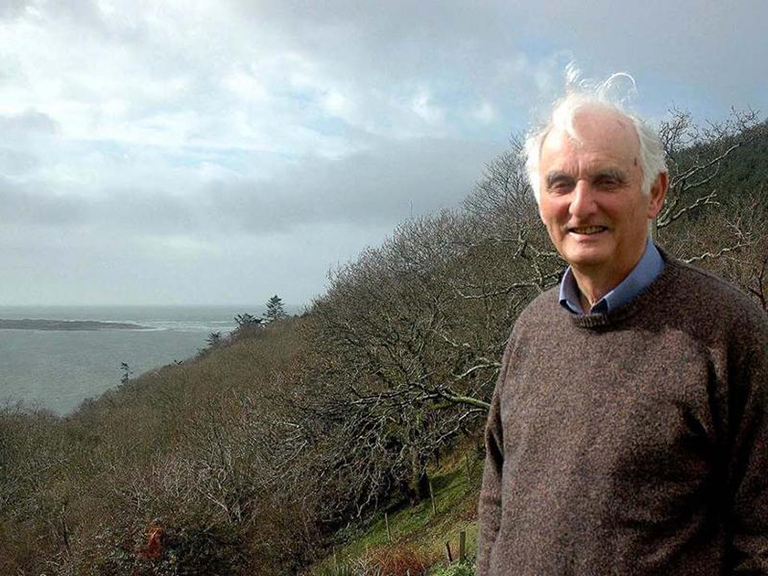
(Sir John Houghton)
JE: What would be your advice to young people with an interest in science and who may be considering their future career?
JH: I would want to encourage them to pursue a scientific career, taking into account first the science which most appeals to them. I have enjoyed enormously the exciting challenge science has provided for me. Then, secondly, to consider as well as they are able the likely uses of that science and its relevance to the community at large. That of course is not easy to predict in advance. For instance, I could not have predicted the importance of what I began to do in terms of its relevance to the climate-change issue. Then, thirdly and most importantly, I would encourage them to pray about it. I recognise many answers to prayer during my career for which I am truly grateful.
JE: In your recent autobiography, In the Eye of the Storm, you have explained the importance of teamwork and co-operation in the field of scientific endeavour. How important is such co-operation in other walks of life?
JH: As science has progressed and knowledge increased, there are fewer instances of lone researchers; much more work is carried out by teams. In any case, whatever the scientific problem, progress can often be made more rapidly through discussion and debate with fellow scientists introducing a wider range of knowledge and skills into the discussion. I would also argue that, in areas other than science, good ideas develop more rapidly and effectively if opened up to discussion with others; also bad ideas tend to disappear quite rapidly after such treatment. In the discussion of matters related to faith, I have found the same is true. As Christians toss their beliefs and experiences to and fro with others, spiritual perspective can be enhanced and key elements of faith strengthened. In addition, others who are not yet believers can be brought to faith by being involved in such discussions.
JE: What keeps you occupied these days?
JH: My main task recently has been to revise the textbook I wrote some 20 years ago, Global Warming: the Complete Briefing for its fifth edition. This has been a much bigger task than I expected, partly because I work much more slowly than when I was younger, and also because of the rapid growth of relevant material. For instance, the most important information available for the revision is information from the fifth report of the Intergovernmental Panel on Climate Change (IPCC), published around the beginning of 2014 (I was involved in the first three IPCC reports between 1990 and 2001). It consists of three volumes, each with 1,500 A4 pages summarising the latest information. I also still give occasional lectures, and I am still able to enjoy walking in the Snowdonia National Park where I am privileged to live.
JE: What books have influenced you most during your life and which ones have you enjoyed reading recently?
JH: Apart from the Bible I have been most influenced by books relating science and faith to each other, for instance books by John Polkinghorne, Alister McGrath and Sam (R.J.) Berry. Recently, I have been much helped by Tom Wright’s Bible commentaries and also have been much stimulated by some of his other books, such as How God Became King, exploring what might be called the ‘big picture’ of the Christian Faith. Most recently I have been helped by The Selfless Gene: Living with God and Darwin by Charles Foster that provides perspective on both creation and evolution. It does not answer all the questions, but suggests helpfully where answers might be found.
JE: Amongst the various volumes you have written, which one is your personal favourite?
JH: Most of my books have been science textbooks or books attempting to relate science to faith. I believe the book I was most pleased to write is my autobiography. But to say I wrote it is not actually true. It came into being because of a letter I received completely out of the blue by someone I did not know who, because of her deep interest in the environment coupled with her Christian faith, wanted to write my autobiography. Gill Tavner was a wonderful ghost writer who wrote a book – that everybody seems to find very readable – that I could never have written for myself, but nevertheless I recognise as my story.
Climate latest from the IPCC
Human-induced climate change is causing dangerous and widespread disruption in nature and affecting the lives of billions of people around the world, despite efforts to reduce the risks.
Moreover, it is the people and ecosystems least able to cope which are being hardest hit, said scientists in the latest Intergovernmental Panel on Climate Change (IPCC) report, released within the last month.
‘This report is a dire warning about the consequences of inaction,’ said Hoesung Lee, Chair of the IPCC.
The IPCC says: ‘The world faces unavoidable multiple climate hazards over the next two decades with global warming of 1.5°C (2.7°F). Even temporarily exceeding this warming level will result in additional severe impacts, some of which will be irreversible. Risks for society will increase, including to infrastructure and low-lying coastal settlements.’
It adds: ‘Increased heatwaves, droughts and floods are already exceeding plants’ and animals’ tolerance thresholds, driving mass mortalities in species such as trees and corals. They have exposed millions of people to acute food and water insecurity, especially in Africa, Asia, Central and South America, on small islands and in the Arctic.’
The report was approved by 195 member governments of the IPCC.


I'm a Christian, and I'm Green - here's why
en does not support any one particular party. However, we are interested in evangelicals within each of our political …