

When people can know God through the Bible in their own languages, it shows them that He has not forgotten them.
The promise in Revelation 14:6 is particularly poignant for Lugwere translator Davis Dedya and his people: ‘The good news being proclaimed to every nation including Uganda, every tribe including Bagwere, every language including Lugwere, and every people. We are not left out of the targeted end point – to receive and enjoy the good news.’
‘New Testament inspired a revival’
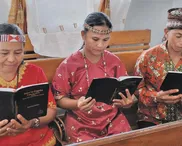
The Lugwere New Testament was published five years ago in Uganda. Since then, translator and pastor Gasyodo Mitala Erinayo observes, church attendance has increased and people are growing in faith.
The availability of Scripture in the language people understand best has meant whole church services are now conducted in Lugwere – prayers, notices, songs of worship and sermons as well as Bible readings: ‘Members started enjoying the service since they understood every step. Besides, the emergence of choirs singing in Lugwere made praise and worship lively. The New Testament inspired a revival.’
‘In their pain God speaks to them’
Meanwhile, in the Central African Republic (CAR), Ngbugu speakers are just beginning that stage of their journey. They celebrated the launch of their New Testament in March of this year.
Over a third of CAR’s population have had to leave their homes due to ongoing violence. Many are traumatised. Ngbugu project leader Tychique Longbo and his colleagues have not been able to live in their home area for almost ten years. And so he looked forward to the day when his people would be able to hold the Ngbugu New Testament in their hands and discover the hope it contains: ‘People are beginning to recover little by little from this crisis. The survivors have resumed their various daily activities; the displaced are beginning to return to their homes. It is in this circumstance that the New Testament in Ngbugu must appear. As a comforter. They will understand that in their pain God speaks to them.’
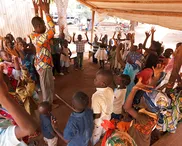
On the day of the launch, the church was full of shouts of joy, ululation, and uniquely Ngbugu-style music – singing, drums and bells. People dressed as traditional warriors and hunters came in ahead of those carrying the New Testament, a dramatic symbol of how precious it was.
Events like these have sometimes been compared to a wedding, or the birth of a baby, a long process leading up to this moment – but with all the growth still to come. Looking to the future, Ngbugu translator Guy Matchi says: ‘I hope that lives will be transformed, people will be reconciled with each other and with God, and Ngbugu speakers will feed on God’s word in their language every day.’
God at our house
For both Lugwere and Ngbugu speakers, the launch of the New Testament in their language has been, like Advent, a time of Immanuel, God with us: ‘Thousands of Lugwere speakers of all walks of life came together to see Jesus Christ being born to us,’ remembers Davis, ‘to dwell amongst the people through the Scriptures, speaking to them in Lugwere, the language they dream in’.
And during the Ngbugu New Testament launch service, a government official encouraged the congregation to make the most of this most incredible opportunity – to know Jesus through the Bible: ‘Zacchaeus had to climb a tree to catch sight of Jesus – we don’t! You can find Him right here, in the pages of this book. He has come to your house today.’
This is why Bible translation matters. As God speaks to people through the Bible in their own languages, we get a foretaste of the new creation: ‘Look! God’s dwelling place is now among the people, and he will dwell with them. They will be his people, and God himself will be with them and be their God’ (Rev. 21:3).

Why I believe God does give us more than we can handle
John the Baptist was dead. Beheaded. It was unjust, brutal, and senseless.On hearing the news, Jesus left what He …