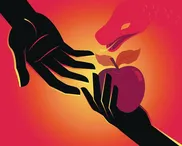
‘What is man that you are mindful of him, and the son of man that you care for him?’ (Ps. 8:4).
When you meet another human being, what are you encountering? As you look into the eyes of a friend, or a parent, or a child, what is it that you see? Is an encounter with another human being different from an encounter with a mouse, or a goldfish, or your pet dog? Is it different from an encounter with an AI Chatbot? Intuitively we think it probably is. But why?
In the early church, the most important questions that Christians had to work through were ‘Who is God?’ (the doctrine of the Trinity), and ‘Who is Jesus?’ (God and man). At the time of the Reformation, the central questions were ‘How can we know God and His will for our lives?’ (the supreme authority and sufficiency of Scripture), and ‘How can sinners be made right with God?’ (justification by faith alone).
In our day, the central questions cluster around what it means to be human, and how to live fully human lives. There is much confusion in our society, leading to much pain and distress. And sadly, this confusion and distress often transfers over into the church. It is therefore vital for us to get our thinking clear.
What is a human being?
In Psalm 8, David reflects on the grandeur of God and His works in creation, and he marvels at the goodness God and His care for human beings. The LORD is surpassingly wonderful: His name is majestic in all the earth, and His glory is above the heavens (vv. 1,9). These heavens, which seem vast to us, are so small to God that He made them with His fingertips (v.3). In contrast to that starry host – and how much more in contrast to the God who made them with His fingers! – we are tiny and seem insignificant. We are not the greatest of God’s creatures, being placed ‘a little lower than the angels’ (v.5; Heb. 2:7). But we are not worms – in God’s love we have been crowned with glory and honour and given a unique place within creation. As the creature made in God’s image (Gen. 1:26-27), we reflect something of His glory in His world. And as those who have been crowned by God, we have been set as kings and queens over the other creatures (vv. 6-8).
In these few verses, Psalm 8 spells out the setting for a Biblical understanding of humanity. As creatures who are higher than the beasts but lower than the angels, we are what theologians have sometimes called a ‘microcosm’ (a little world). In our tiny frames we combine the heavenly and spiritual (our souls) and the earthly and material (our bodies). Seemingly small and unimportant, we are unique creatures of the LORD, the God of glory – set in this world to know Him and to love Him, and to rule creation in His image and after His likeness. For all our frailty, this gives us an extraordinary dignity; for all our greatness, it humbles us in relation to Him.
God willing, this article is the first of three, in which I hope to sketch out some of the most important aspects of a Biblical doctrine of humanity. Few things could be more important for us in our day and age. We start this month with consideration of humans as creatures. In future articles, I plan to consider us as fallen and sinful, and then as redeemed and glorified. What follows cannot cover everything (see the further reading at the end for more help). But it will cover some of the more important topics.
Created from nothing
To be human is to be a creature. ‘In the beginning, God created the heavens and the earth… And God said: “Let us make man in our image, after our likeness…” ’ (Gen. 1:1, 26). There is therefore an absolute distinction, and an infinite distance between God and us, because He is the Creator and we are creatures. He exists independently of anyone and anything else; we exist in complete dependence on Him. If we did not exist, God would be unchanged. Nothing would be lost. Creation adds nothing to God’s greatness, goodness or happiness. In fact, creation adds nothing to the sum total of greatness, goodness, happiness or existence because in Himself God is all of those things infinitely. God plus creation is in no way greater or better than God alone. This means that God did not create out of any sense of need. Creation is an act of absolute generosity. As our creator, God gives life, needing nothing in return.
In contrast, without God, we would be quite literally nothing. To say that we are creatures is to say that by Himself – with no helpers, and needing no raw materials to work with – God brought us into existence from nothing. He tells us that He made ‘all things … alone … by myself’ (Isa. 44:24). By faith, we learn that ‘the universe was created by the word of God, so that what is seen was not made out of what is visible’ (Heb. 11:3).
This immediately tells us three things about what it means to be human. First, it tells us that because God is the Creator and we are His creatures, He does not need us at all. But we need Him absolutely. At first glance, this might seem a harsh truth. But in reality it is profoundly liberating, because it means that weakness and dependence are not a bug, but a feature in human life. Many of us feel this; all of us will eventually feel it – we are weak and vulnerable. And we are weak and vulnerable because we come from nothing. But wonderfully, in God we have an infinite ocean of life and goodness to live in and by, as we come to Him by faith in Jesus.
Secondly, it tells us that as our creator, God gets to tell us what shape our life should take. We do not create and shape ourselves, and so we do not get to decide how we should live. Because we are creatures, the authentic shape of a human life is this: ‘from him and through him and to him’ (Rom. 11:36). We come from God, as our creator. We live in and through Him, as He sustains our lives, and as He redeems us in Christ and by the Spirit. And we live to Him, or for Him. In the words of the Westminster Shorter Catechism, our chief end (our true purpose) is ‘to glorify God and enjoy Him forever’. Anything less than this is less than authentically human.
Thirdly, it tells us to reject the God-given shape, purpose and goal of our lives is not the path of freedom. Rather, it is an attempt to unmake ourselves. Life without God is a contradiction in terms: it is self-destructive folly.
Let’s now look a little closer, and see what it was that God made when He made us.
Bodies… and souls?
When God made you, he made you as a body-soul unity. He made you with a mind to know Him (John 17:3), a will to love Him and your neighbour in true righteousness and holiness (Eph. 4:24; 5:1-2), emotions to enjoy Him (1 Peter 1:8), and a body to serve Him (Rom. 12:1).
Exactly how our souls and bodies relate is complicated. One theologian has counted at least 130 different views(!) Here’s a really simplified summary. Grab a cup of coffee and try to stay awake… I’ll try to point out why it matters as we go.
First comes the view of the Greek philosopher Plato (c.427–348 BC). He argued that we are made up of two separate substances, a soul plus a body, but the ‘real me’ is my soul. In this life, my soul is imprisoned in my body, and ‘salvation’ is finally to escape the body and the world of the senses. Who am I on this view? I am a soul imprisoned in a body.
The French philosopher René Descartes (1596–1650) came up with a modern twist on this when he argued that what I really am is a mind – a thinking thing. On Descartes’ view, we could say that I am a ghost in a machine. This might seem strange. But if you shift from ‘thinking’ to ‘feeling and desiring and wanting’, it’s not a million miles from how many people today understand what it means to be human. What am I? I am a bundle of strong desires that should not be limited by the body I just happen to have.
The problem with these views is that the Bible is clear that bodies are created by God, and they are good. And the Christian hope is not that I will become a disembodied soul, but rather that one I day will be raised in my body to eternal life, just as Jesus was raised from the dead. My body is not a prison; nor is it just a machine I’m trapped in. It’s part and parcel of who I am, and it’s good.
An alternative set of viewpoints are known as materialism. One example would be Richard Dawkins, who claims that we are just survival machines for DNA. We might describe this as the meat computer view. We are simply a complex set of biological, chemical and electrical processes. But is that really all I am? And if I am just that, what becomes of my freedom and individuality?
Some theologians and Biblical scholars also argue for a version of materialism, although they would not want to reduce us to our biological processes. The strength of this view is that it takes our bodies seriously. The problem is that it can’t make very good sense of the way Jesus talks about those who can kill the body but can’t kill the soul (Matt. 10:28). It also has problems with the Biblical teaching that after Christians die, and before the final resurrection, their souls are separated from their bodies and go straight into the presence of Jesus (2 Cor. 5:1-10; Phil. 1:22-23).
Animated bodies
The best way to understand how God has made us is to think of ourselves as ensouled, or animated, bodies. The Italian reformer Peter Martyr Vermigli (1499–1562) explained that the soul is the ‘drive’, or ‘motor’, and the ‘form’ of the body.
As the ‘form’ of the body, my soul is what makes this collection of atoms and molecules a human body, and, in fact, my body. As the ‘drive’ or ‘motor’ of my body, the soul is what gives life to my body. It’s helpful here to know that the Latin word for soul is anima. This word stands behind the English word ‘animal’. An ‘animal’ is something with a soul, something living. A human is a particular kind of animal – one with a rational soul. Similarly, we say that something like a rock is inanimate, meaning it isn’t alive. So, what am I? I am a body, but not merely a body. I am a living body. An animated body. An ensouled body.
This makes excellent sense of the way Genesis 2 describes the creation of Adam. It’s a two-stage process. First, God forms the man’s body from the dust of the ground, like a potter forming a clay pot. Then, the Lord breathes into his nostrils the breath of life, and the man becomes a living being (Gen. 2:5-7). What is Adam? A living (animated, ensouled) body.
Moving to the other end of life, what happens when the soul and body are separated? The body dies (James 2:26), because it loses its animating principle. It also loses its ‘form’, the thing that makes it a human body. When I die, my soul is separated from my body. Having lost its form, my body will slowly disintegrate, and its atoms and molecules will become something else entirely.
There are three big advantages to this way of understanding the relationship of soul and body. First, it makes good sense of the teaching of the whole Bible taken together. Secondly, it places a high value on our bodies: they are fundamental to who we are. But, thirdly, it emphasises that our bodies are not all we are. We also have souls. And, although our souls and bodies belong together, in the end our souls are far more precious. ‘Don’t fear those who can kill the body, but cannot kill the soul’, says Jesus. ‘Rather, fear him who can kill both body and soul in hell’ (Matt. 10:28). It is better to have a healthy soul and a sick body, than to have a healthy body with a sick, sinful soul.
Male and female
But if God made my body, what kind of body did He make? Jesus gives the answer by pointing us back to Genesis 1–2 (Matt. 19:4-5). Jesus quotes Genesis 1:1, ‘From the beginning’. Then he quotes Genesis 1:26-27, ‘God created them male and female’. And then He quotes Genesis 2:24, to explain why we are created male and female: ‘Therefore a man shall leave his father and mother and hold fast to his wife, and they shall become one flesh’.
When God makes us male and female, He makes us with many things in common. When Adam names the animals, he learns that he is alone, and not like them (Gen. 2:18-20). But when God brings the woman to him, you can hear Adam’s cry of relief: ‘This – at last! – is bone of my bones and flesh of my flesh’ (Gen. 2:24). ‘Bone of my bones and flesh of my flesh’ means, ‘We’re family!’ (See Judges 9:1-2; 2 Sam. 5:1; 19:13). In English, we might say: ‘She’s my flesh and blood’.
So, in contrast to all other creatures, men and women, boys and girls, even infants in the womb, are flesh and blood – family. We are united by a shared nature and common bonds of affection. We are equally in the image of God, with equal value and dignity. We equally have rational minds, free wills, a full range of emotions, and well-designed bodies, given to us by a loving and wise creator. We belong to the same species. More than that, we are family.
But we are also different. When God created Adam, He formed him from the dust of the ground (Gen. 2:5-7). The Hebrew word translated ‘formed’ is used of a potter, moulding clay. Adam’s name shows us where he comes from (the Hebrew for ‘ground’ is ’adamah). Adam is an earthling. And, as we have seen, he is created in two stages. First, his body is formed. Then God breathes into his nostrils the breath of life.
The woman is different. Unlike Adam, she is made in one step, not two. But like Adam, her name reflects where she comes from. Adam is formed from the ground – earthling from the earth. Eve is formed from Adam’s rib (Gen. 1:21), and is described as woman from the man (Gen. 1:23). (The pun works in a similar way in Hebrew: she is ’isshah from the ’ish.)
When God creates the woman, she is not ‘formed’, she is ‘built’. It’s an architectural word – not God the potter, but God the master builder. The word appears frequently in 1 Kings 6–8, when Solomon builds the Temple. Because here, even as He creates the first bride, God is giving us a glimpse of the gospel. One day there will be a Second Adam (Jesus), and for Him, too, God will build a bride (the church), who will be for Him a body, a temple and a city (Eph. 1:22-23; Eph. 2:11-22; 5:22-33; Rev. 19:6-9; 21:1-5). And with and in His bride, our Adam will succeed where the first Adam failed, and will be fruitful and multiply and fill the earth and subdue it and we shall be blessed forever (Eph. 1:3, 22-23).
You see the point? Men and women are different from one another. And those differences are inscribed in our bodies. It’s wonderfully clear in the opening chapters of Genesis. But in all honesty, we don’t need the Bible to tell us this. Normally we notice with a glance whether the person coming towards us is male or female. It’s clear in the shape of our bodies, and also in our faces. And even very young children soon learn to tell the difference.
Our good and wise creator has made us male and female. And He has made each one of us either male or female – from the beginning, down to today, so that we can marry and be fruitful and multiply and fill the earth and subdue it. That’s how our bodies work (I trust you don’t need the biology lesson here), and that’s somewhere near the heart of the meaning in this life of our bodies as male and female.
Very good
The last thing for us to see is that because God is very good (Ps. 119:68), as those made in His image, we are also very good (Gen. 1:31). We’ll think about sin next time, but for now it’s important to see that regardless of our sin, God’s handiwork is superb. This has huge ethical implications. If we recognise that we, and all people, come from the creative genius of the good God it will radically change how we think about the value and dignity of human lives.
If life is about autonomy and self-fulfilment, what happens if someone gets in the way of me living the life I want to live? What happens if an unwanted baby threatens to upend a couple’s life? What happens when someone gets old and weak and feels themself to be a burden on others? What happens if instead of a life of happiness and fulfilment I find my life to be filled with darkness and trauma or failure and despair?
The theologian John Webster puts it like this: ‘God is the ground of creatures; without Him, all is surface, and apart from Him appeals to [human] dignity can scarcely be more than cries of alarm, or prohibitions, or commands which lack final authority to compel action.’ Without God… But in reality, there is no ‘without God’. As good creatures of the good God, even at our worst, even at our lowest ebb, our lives have unimaginable dignity and value. This dignity is not something we choose for ourselves, it just is, because God has given it to us as a gift.
This means that the fundamental posture we should have towards other people, and towards ourselves, is simply this: ‘It is good that you exist’. No matter how old and frail someone has become: ‘It is good that you exist’. No matter how badly someone has hurt me: ‘It is good that you exist’. No matter how bleak my life: ‘It is good that I exist’.
The goodness and dignity of all human life is not a matter of private religious conviction. Nor is it a matter of different valid opinions that we should tolerate in a secular, pluralist ‘inclusive’ society (which seems quite happy to exclude the weakest and most vulnerable). It is a question of reality.
We are creatures, God is the creator. And so we do not get to decide which human beings have dignity and value. Lawmakers do not get to decide. Doctors do not get to decide. Ethicists do not get to decide. Parents do not get to decide. Children, or spouses, or caregivers do not get to decide. I do not get to decide for myself about myself. The dignity of every human without exception is not contingent on social affirmation. It is simply there – because God is good. And therefore His works are good. And the human products of His work bear the very image of God Himself. And so we are very good.
Further Reading
If you’d like to think more about what it means to be human, here are three recommendations for further reading.
Something Old:
Thomas Boston, Human Nature in its Fourfold State (Banner of Truth, 1964).
Originally published in 1720, this was the most frequently published book in 18th-century Scotland. It’s easy to see why it was so popular: it’s a profound, Christ-saturated journey through the four stages of our existence – as created, fallen, redeemed and perfected.
Something New:
Ros Clarke, Human: Made and Remade in the Image of God (IVP, 2023).
I am a bit of a Ros Clarke fanboy. She always writes beautifully and draws from deep Biblical wells. This book was originally written for the Keswick Convention. It’s very readable and well applied.
Something Stretching:
Petrus van Mastricht, Theoretical-Practical Theology, Vol 3: The Works of God and the Fall of Man, 1.3.9, ‘Man and the Image of God’, pp. 247-307.
Mastricht’s Theoretical-Practical Theology was Jonathan Edwards’ favourite book outside the Bible. This is a rich Biblical and systematic account of humans as God’s creatures made in His image, accompanied by warm and helpful practical applications.