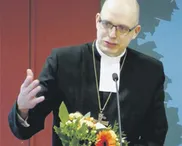
A leading evangelical expert on ethical issues has said ‘each one of us must do what we feel is right’ when it comes to Covid vaccines.
Professor John Wyatt, Emeritus Professor of Neonatal Paediatrics at University College London and current President of the Christian Medical Fellowship, told en he thought there was ‘a duty of Christian love to be vaccinated … in order to protect my neighbour’.
The Pfizer-BioNTech vaccine currently being rolled out across the UK was not developed or produced using any tissue from an aborted child, though it did make use of a biological assessment tool that relies on a cell line (HEK-293) derived from a baby aborted in 1972.
Wyatt said: ‘I may feel that it is better to receive protection from the virus even if the vaccine is “morally tainted”, because the alternative of not receiving any protection is worse.’
But he added: ‘Of course, if there is a choice to have an alternative vaccine which is equally effective but which hasn’t been derived from a human foetal cell line, then this will be the preferable approach.’
Speaking to Evangelicals Now, Wyatt said: ‘Biblical thinking about human beings living in communities tends to focus on our responsibilities to others more than on our own rights.
‘God calls on His people to care for those who are most defenceless, and in the context of the pandemic it seems clear who are the most defenceless in our midst: the elderly, the frail, those with pre-existing health conditions, and many in ethnic minority groups,’ he added.
‘By agreeing to be vaccinated I am exposing myself to a tiny risk, but I am minimising the chance that I will spread the potentially lethal virus to another person. Each one of us must do what we feel is right. I see a duty of Christian love to be vaccinated, not only to minimise the risk to my own health but in order to protect my neighbour,’ he declared.
Wyatt rejected the concerns of some people that excessive risks were being taken with the health of the public. ‘On the basis of the current evidence the vaccine is far safer than the majority of the medications that are prescribed every day by NHS doctors,’ he said.
Speaking about the link between some Covid vaccines and abortion, Wyatt said: ‘For many years biotechnologists have used what are known as “immortal cell lines”. These are cell cultures which continue to grow because the cells keep multiplying indefinitely. The advantage of these unusual cell lines is that they can be very precisely characterised and their properties remain constant over years or even decades. However, some of the frequently-used cell lines are associated with complex ethical questions because of where they came from.’
One specific cell line, HEK-293, is widely used for vaccine development. The Pfizer-BioNTech and Oxford University/ AstraZeneca vaccines use that line as do others.
Ethical challenges
Wyatt said that the ethical challenges for a Christian working in a lab, or for someone who decides in what technologies to invest, were different to the choices faced by most people.
‘Clearly if I have a chance to influence decisions for good and away from evil then I have a responsibility to do so,’ he stated. ‘And if I can’t influence the decision then, for example as a Christian working in the biotech world, I may choose not to work on a particular cell line, and even resign my job out of conscience if I have no alternative.
‘But I may feel that it is better for me and my loved-ones to receive protection from the virus even if the vaccine is ‘morally tainted’, because the alternative of not receiving any protection is worse. Of course, if there is a choice to have an alternative vaccine which is equally effective but which hasn’t been derived from a human foetal cell line, then this will be the preferable approach.
A ‘disputable matter’
Meanwhile, writing on the website of the Centre for Christianity in Society, director Dr Paul Coulter said: ‘The category into which the question of accepting a vaccine made using foetal line cells fits, I believe, what the apostle Paul called a “disputable matter”…’
He concluded: ‘If you decide that you can, I don’t think you should do so without pausing for a moment to remember the baby that was killed. It should be a solemn thing, not a celebratory thing. If you decide that you cannot, be certain to do all you can to preserve others from harm by continuing to take measures not to spread the virus. Whatever you decide, welcome one another as Christ has welcomed you, for the glory of God.’