
Gordon Bridger, the former principal of Oak Hill College, has passed away.
Born in London in 1932, he was educated at Christ’s Hospital, and studied theology at Cambridge University. After ordination he served in churches in London, Cambridge, Edinburgh and Norwich, before becoming principal of Oak Hill Theological College from 1987 to 1996. In retirement he travelled and taught more widely – including among former students of his in Uganda and Tanzania. He was also part of the preaching team at Cromer Parish Church in Norfolk.
Bridger wrote a number of books, including a commentary on the Biblical books of Obadiah, Nahum and Zephaniah, in The Bible Speaks Today series (IVP). This covered major Scriptural themes including the nature of God, sin and judgement, repentance and faith, and future salvation and restoration. It also touched on sleaze among political leaders, unfaithful religious leaders, crimes against humanity and persecution of God’s people.
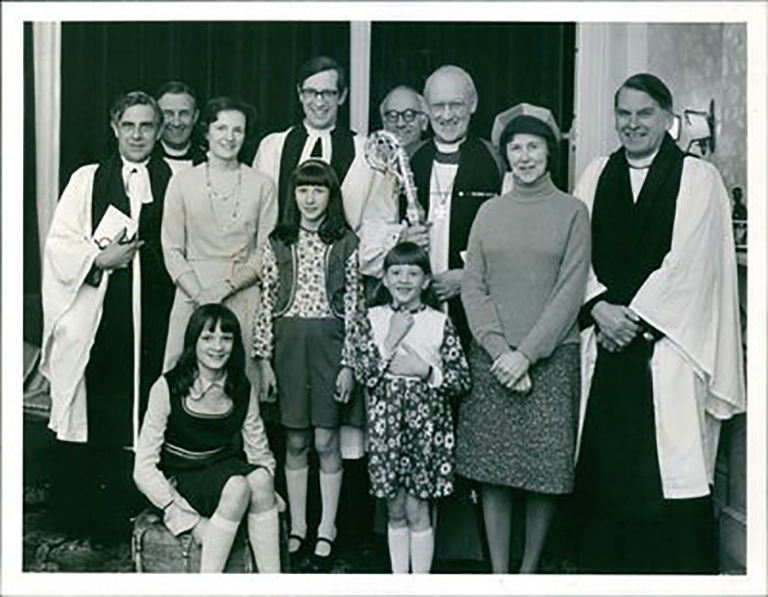
(Photo: Gordon’s induction at Holy Trinity Norwich in 1976 (from left to right) Archdeacon (later to be Bishop) Timothy Dudley-Smith; Canon Mark Ruston, of the Round Church and Rural Dean of Cambridge; Mrs Elizabeth Bridger; Canon Gordon Bridger; The Revd David Bubbers, Gen. Sec. of CPAS; Bishop Maurice Wood, Bishop of Norwich, and his wife, Mrs Margaret Wood; The Revd John Philips, Rural Dean and vicar of Eaton; The Bridger children are (seated) Rachel, Sarah and Mary)
A cricketing enthusiast, Gordon was also a keen supporter of the Arsenal Football Club. He and his wife Elizabeth had three married daughters and ten grandchildren. They shared an interest in music, and love for the Norfolk countryside.

Oak Hill said: ‘We’re … grateful to the Lord for his life and ministry. He was once asked: “What’s the best advice that you wanted to leave with the students?”... Answer: “I hope that we’ve both taught and modelled what the pastoral epistles say about ministry. So I hope they see the importance of godliness.”’
Gordon Bridger in his own words, in en
In 1996, when he retired as principal of Oak Hill College, en interviewed Gordon Bridger. This is part of that feature.
Q: What was the most important thing that you learned as principal?
GB: The realisation of God’s sovereignty. I was dragged, screaming, from parish life! I thought there was nothing better than serving the Lord as a parish minister, so why should I leave it? And, anyway, I’d had no experience of higher education, so it didn’t seem a particularly sensible appointment! But I came to see that if God is calling you, He does actually equip you and help you.
Q: What’s the best advice that you wanted to leave with the students?
GB: I hope they see the importance of godliness. As Murray M’Cheyne once said: ‘It’s not so much great talents that God blesses, but great likeness to Jesus’. Also, that they see that importance of being ‘apt to teach’ – teaching the word in season and out. … Also, I would tell them to go on to do the work of an evangelist. Whether they see themselves as gifted as such or not, I hope that they’ll be good servants and fulfil a servant role in their pastoral ministry.
Q: What thoughts do you have on issues currently exercising the evangelical constituency?
GB: I hope people will see the importance of Biblical reasons for whatever position that they hold. I hope people will be able to differentiate between what are primary gospel issues and those which are secondary.
For example, Biblical teaching on matters of church order and government are far less clear than teaching on moral issues such as homosexuality. With regard to the latter, it seems to me that Scripture clearly condemns homosexual practice. On secondary issues like infant baptism, for example, we should be able to say: ‘OK, we differ, but I am able to accept you as a brother and not write you off’. You have to be able to say: ‘I could be wrong – we’re both trying to be Biblical, and I won’t write you off, and I hope that you won’t write me off’.
What saddens me about some of the current evangelical debates is that the term ‘conservative evangelical’ seems to have narrowed, so that if you don’t hold the view, for example, that women should never teach men, you are no longer regarded by some as a proper evangelical! To believe in the supremacy and sufficiency of Scripture in all matters of faith and conduct leaves space, in my view, for different understandings of some secondary issues.