

The Slavic Gospel Association (SGA) is a supporter of the Grace Shelter, an orphanage run by Grace Church (Baptist) in Odessa, a port on Ukraine’s Black Sea coast, since 2004.
Fifty-three children, aged from about three to 18, and their ‘orphan parents’ lived there. The site also hosted a ‘transition house’, which provided a number of small apartments for young adults for a couple of years whilst learning to become independent.
When the Russians invaded, Odessa was a key target city and quickly evacuating the children to safety was paramount. After a dramatic and terrifying escape, everyone reached safety in Poland at 4am on Saturday 4 March, completely unharmed.
Evangelicals Now has been granted an exclusive interview with Igor Bandura (see photo above with his wife Anna), the former pastor of Grace Church before he became Vice President of the Baptist Union of Ukraine. He was instrumental in planning the escape and this is their extraordinary story:
How did the orphanage come to exist?
‘When we planted Grace Church we wanted to do something for our community, and drug addiction was one of the biggest social ills in Odessa. But we quickly realised it was a bad idea to have a rehabilitation centre at the church building because it would cause many problems. So instead we decided to move it away and asked God to direct us how we could best use the building. And then God answered our prayers in a very special way. One summer morning our deacon found three street boys sleeping in an old truck in our backyard. They had been there for a month as Odessa is quite warm during the summer. When we talked to them, we felt God was guiding the church to start a ministry to street kids and orphans.’
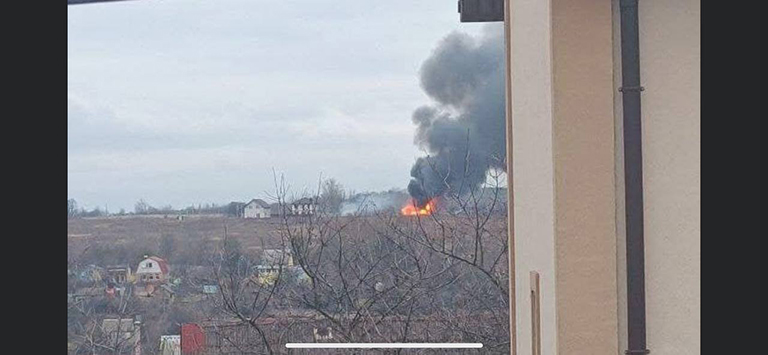
How close were you to the fighting?
‘It was very close (see photo above); bombs and missiles were exploding just a few hundred metres from the Shelter. Our buildings are very close to the sea and the beaches had been mined by the Ukrainian army to stop any invasion from the sea – Ukrainian heavy armoured vehicles and artillery were everywhere. Odessa was under threat from the land, too, and had Mykolaiv, a few miles to the east, been captured the road to Odessa would have been open and Russian tanks could have been at our door within hours’.
How did the children react to the Russian invasion?
‘The threat was very real and they could not understand what was going on, why they couldn’t go to school anymore, why they had to stay at home, why it was so loud, why they had to sleep on the basement floor. They even put signs on the windows warning the Russians ‘Orphan children here – be careful’. It was very bad for their mental health and I was very happy when we learned that, with the support of our government, they could perhaps escape this horror’.
How did the evacuation happen?
‘For three days the children had their own little bags packed, ready to move at any time. The original idea plan was for a bus to drive them to Moldova, the shortest route to safety, but the bus had not enough fuel to get there. And the driver was only 45, fighting age, so was not permitted to leave the country. Then the government said it would provide a bus and a security car, but fighting along the route meant it was too dangerous for the children to travel that way.
‘That left taking a night train. We drove the children to the station and the police put them on a train and it left almost immediately. But instead of the journey taking ten hours as normal, it took nearly a day to reach Kovel in western Ukraine. Then they were put on buses and taken to the Polish border. That crossing took six hours and finally they reached a church in Chelm, which gave them food and where they stayed the night. Miraculously, someone then gave them €1,000, which was exactly what was needed to hire a bus to go to Ruptawa in southern Poland, which was their final destination. It was God providing along the way. They arrived the following day, completely exhausted’.
Why did you go to Ruptawa?
‘This was another wonderful provision from the Lord. Derek Maxwell of the SGA called me and said we have friends and partners in Poland who wanted to help refugees, so I looked them up on the internet. And because we had no other options, and I hated to think of them sleeping on a school floor without any friends or Christian community around them, we went with them. The most important thing for me is safety and being part of a Christian community. And so they all got to Ruptawa thanks to the SGA’.
How long can you stay there and what does the future hold for the children?
‘Ruptawa is a temporary solution, for perhaps a month or two while we decide what to do. It currently costs £650 a day to keep the children here. There are various options for the future and we will ask the orphan parents what they think best for the children.
‘The problem is that so much has been destroyed already. No one knows how heavy the fighting in Odessa might be, whether the orphanage will be badly damaged, making it not the best place for the children to return to. And even when this war is over, I wonder how much state support our government will be able to provide for them. Before the war it was about 40% of the costs of the orphanage, the rest coming from partners such as SGA. Right now we are praying, we are getting information and we are asking God to guide us as to what we should do for these children’.
Derek Maxwell, General Director of the SGA, said: ‘Grace Shelter and the Transition House have been close to our hearts for many years. We helped with the construction of the buildings, supported the ongoing work of the orphanage and part-sponsored the orphan parents for 22 years. We sought to do all we could to help evacuate the children and remove them from danger. Our mission works with local Christians across eastern Europe, so we were delighted to make use of those contacts and help organise the temporary home for the children in Ruptawa.’


