Catherine Haddow asks if psychology can be of benefit in pastoral care
I was converted back in 2004 and at the time I was working as a Chartered Psychologist for a psychological consultancy firm in London.
I was contracted in to work in many different types of organisation. It was really interesting work and I loved it.
I’ve always studied people interacting. How people think, feel and behave has always fascinated me. My husband always says I am a nightmare to take out for a meal as I’d grab the ‘prime seat’ (the one facing into the restaurant to enable optimum ‘people watching’) and would then give a running commentary on ‘interesting observations’ – sorry hubby, not very romantic. Now we have three children we no longer go out for meals, so he no longer has to contend with strangers during a romantic meal with his wife!
Everything changes
As many readers will testify, after conversion everything changes and we suddenly find ourselves reassessing many things in our lives in the light of God’s Word. For me, this included my role as a psychologist and I found myself considering my much loved career very carefully. I had such a burden on my heart for those suffering emotional distress within the church and felt I wanted to try to use my training for the benefit of Christians.
As I began to look around me in church I could see areas where psychology could bring a great deal of help into the pastoral care of individuals struggling emotionally. Sadly, Christians often experience as much emotional distress as those outside of Christ and have concerns others may not, such as not experiencing the joy Christians are ‘supposed’ to always feel (aren’t they?). This can add to depression and anxiety, presenting as a lack of assurance, and the (false) belief that God has left them can often follow.
Deep emotional difficulty
We shouldn’t underestimate the amount of deep emotional difficulty in our churches today. (The charity Renewing Minds is doing a wonderful job in raising awareness of this and providing accessible training for leadership and pastoral care teams).
This emotional suffering is often deliberately hidden from most. We need to help people to be more open with brothers and sisters in Christ in our suffering, because there is no shame in experiencing emotional difficulties. We are all on the same emotional spectrum because we all have the same hearts, hearts that are naturally inclined away from God. It doesn’t take much of a change of circumstances to dramatically alter where we are on the emotional continuum.
How to help?
As uniquely created, complex combinations of the biological and spiritual, living in a fallen world, we all think, behave and feel inappropriately at times. Anyone who presents with emotional difficulties which regularly affect their spiritual walk needs help. So, how we are we to best help Christians struggling emotionally? Do Christians need psychologists when they have pastors, leadership teams and, of course, God himself to help them in emotional struggles? What is clear is that for some, in the same way as people may need professional help for physical health needs, there is a place for help for psychological needs too.
Though there is much excellent pastoral work going on, some appear reluctant to go to pastors for help regarding emotional difficulties, fearing being misunderstood, embarrassed, dismissed or afraid of the consequences of, perhaps, admitting to addictions, etc. This seems particularly true of some women, which also emphasises the need for dedicated women’s workers in ministry. The importance of bringing mental health issues on parity with physical health issues in the church is crucial, but applying psychology in the absence of gospel discipline can also bring about unhelpful spiritual implications. We are told to ‘test all things’ (1 Thessalonians 5.21) and that is what I found myself doing with my chosen career.
Therapeutic discipleship
My desire was to re-define and refine my approach to provide ‘therapeutic disciple-ship’, drawing on Scripture to get right to the heart of the matter, for the purpose of helping Christians walk their path following Jesus just that little bit straighter. (Biblical Counselling UK is a fantastic organisation that advocates this approach for counselling). I initially used a cognitive behavioural approach (CBT), which for me, is the psychological model which best fits with Christianity. It focusses on people’s beliefs and perceptions about events and the subsequent (emotional, behavioural and physiological) consequences of those beliefs.
As I ‘tested all things’, I felt it reconciled well to what we are told in the Bible. For example, in Acts 17 we see the Apostle Paul reasoning and engaging people’s thoughts with a view to changing beliefs, so that in Acts 17.34 ‘some people became followers and believed’. Likewise, once our thoughts are changed, it changes our emotional responses such as joy and peace, which affects our behaviour and may lead to repentance.
The trouble we often face is that we can be led by our feelings instead of by the gospel truth in our hearts. Feelings are good ‘mirrors’ of the heart, but poor leaders. I believe that when someone is experiencing difficult emotions that are affecting their everyday life, God is revealing something about their hearts. It’s a bit like a spiritual smoke alarm going off alerting us to the need to look more carefully into our hearts and listen to God’s voice. Proverbs 27.19 tells us ‘as water reflects the face, so one’s life reflects the heart’ and if that person’s life is crippled by anxiety that is saying something about their heart.
CBT
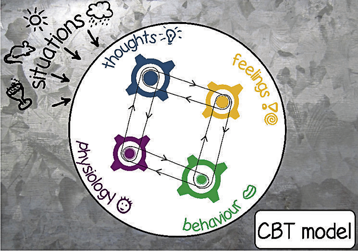
Using the CBT approach, there is a lot that could be done to help that person identify and alter their thought patterns, which would calm their physiological response and alter their emotional response – thus changing their behavioural response. But there was still something missing for me in this approach, so there needed to be some refining. What was missing was an intentional look at the ‘heart’ through Scripture. There has to be heart change for sanctification and therefore I felt the heart had to be explicitly addressed when helping someone struggling with difficult emotions.
TBH
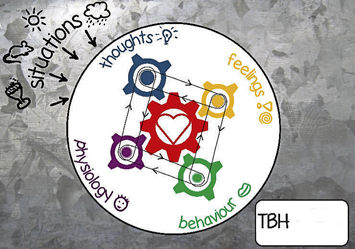
By adapting the CBT model to be the ‘TBH’ model (Thought, Behaviour and Heart) those struggling in the grip of difficult emotions can be helped to see what Scripture reveals about their heart motives and how this in turn is affecting their thoughts, their internal physiology, emotions and behaviour.
Proverbs 4.23 tells us to ‘keep your heart with all vigilance, for from it flows the springs of life’. For example, if our spiritual walk is pervaded by repeated angry outbursts, it is revealing something about our perceptions of the situation. Our thoughts about the situation activate our internal physiology (pumped up for ‘fight mode’) which reveals the emotion of anger shown through our outburst (behaviour). This anger emotion acts as a spiritual smoke alarm revealing the state of our heart when seen in the light of Scripture. That’s what needs addressing, what is going on in the heart!
My desire to provide ‘therapeutic disciple-ship’ could only be done through Scripture penetrating hearts, and by the work of the Holy Spirit, but the nature of emotional suffering means that there is often so much emotional ‘noise’ that reading the Bible and praying can be extremely difficult for the individual. Accompany this with spiritual warfare and a believer can find themselves in a downward spiritual spiral. Using the TBH approach to come alongside someone who is struggling, helps the different components of the emotional difficulties to be examined, while always centring around the heart in the light of Scripture.
So, can psychology be of benefit in pastoral care? Yes, I believe it can. Working in conjunction with pastors and pastoral care teams, I believe it is possible to provide a sound, biblically grounded and robust psychological process within the church. It can provide a much needed outlet for Christians to be supported and helped to listen to God as he reveals heart issues through the trials of difficult emotions.