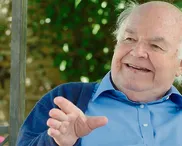
Evangelicals Now speaks to Professor John Lennox about his new book on Artificial Intelligence (AI)
Never mind Artificial Intelligence – the subject about which I am just about to interview John Lennox. It’s my own lack of natural intelligence that is worrying me as I log on to Zoom to chat with him about his new book 2084 – Artificial Intelligence and the Future of Humanity, and also his recent bestseller Where is God in a Coronavirus World?
After all, John Lennox is Professor of Mathematics in the University of Oxford (Emeritus). Whereas I am not. And sadly my fears are all too quickly realised as I begin by complimenting the professor warmly on his rich Scottish accent – only to be informed that it is in fact Northern Irish. Whoops. But he is very gracious.
en: Thank you very much for taking the time to speak to en. Tell us first of all about the book Where is God in a Coronavirus World? How did you come to write that and get it out so quickly?
JL: I appreciate Evangelicals Now, so it is an honour for me to be involved in this interview! What happened was that at the beginning of lockdown I thought: ‘What am I going to do now?’ because I have a fairly extensive programme of travelling and conferences. So I thought: ‘What can I write? People are going to get scared. They are going to be asking the big questions.’ I wanted to demonstrate that Christianity has something non-trivial to say about these things. I sat down on a Monday morning, wrote until Saturday evening and then contacted the publisher, and by Wednesday it was in print!
en: Heavens above! Ten days!
JL: It’s spectacular. The Good Book Company – they were amazing. They have brokered it going into 28 languages now.
en: You’ve written your new book 2084 – tell us in a nutshell what it’s all about.
JL: Oh, I don’t work in nutshells! (laughs). Nutshells are usually empty! The title of the book is 2084 – Artificial Intelligence and the Future of Humanity, and I had several motives in writing it.
First of all, AI has two very clearly distinct aspects to it. The first is ‘narrow AI’ – and that’s the stuff that’s already working. What is that? It’s basically a fairly powerful computer, a large database and an algorithm – a set of rules that recognises patterns. A good example is X-rays of lungs, say, which of course is important in Covid-19. You get a million X-rays of people’s lungs and doctors label them with their associated diseases. Then you get an X-ray of your lungs, and it is rapidly compared by this system and it comes up with a diagnosis which will these days be better on average than you get in a local hospital. That system is doing something – one thing and only one thing – which normally requires human intelligence to do. The system itself is not intelligent, but it simulates intelligence. What comes out is something it would normally have taken a human to do. I wanted to explain that. There are aspects of this which are very useful, very important and going places.
But then I wanted to point out that even at this level there are all kinds of ethical problems: the main one is surveillance – whether of the Western kind, with the data we are mostly voluntarily giving into our smartphones that’s being sold without our permission. And a lot of money is being made out of it. But even more serious is the kind of ‘surveillance Communism’ that’s operating in Xinjiang [China] and suppressing a whole culture, the Uighurs. This is 1984. We’re nowhere near 2084 and yet we’re seeing increasingly around the world the effects of ‘Big Brother is Watching You’ and we’re sleep-walking into it. So I wanted to alert people to this. The big danger we all face is that the technological progress outpaces the ethical progress.
en: So do you have a smartphone? Do you use it?
JL: I do, yes. But I am very careful. I don’t have any personal identity on Facebook or any of these platforms. But I do use the phone and I know it is a risk. I turn it off quite frequently because who knows what it’s recording? Commercial surveillance capitalism is a scary area. People harvest data from us and sell it on. And the danger is it may be used against us eventually. So we’re in a scary situation. I don’t have an ‘Alexa’ [Amazon smart speaker] or anything like that. It can be recording. Someone bought a robot vacuum cleaner and after a couple of weeks they were receiving adverts on their smartphone saying ‘your sitting room would look good if it had this furniture in it’ – the machine had cameras and was recording the whole house as it drove around vacuuming the floor.
en: And secondly, as well as ‘narrow AI’ there is also ‘AGI’ – Artificial General Intelligence – and the Israeli author Yuval Noah Harari has written about this in his book Homo Deus. You say his thesis is that we can upload our minds on to computers and therefore exist with immortality – an idea you reject.
JL: Again, AGI splits into two. With AGI there is firstly enhancing existing humanity and, to quote Harari, turning ‘humans into gods’ – homo deus. The second idea is the one you have just mentioned and that is starting from some non-biological material like silicon to try and construct artificial life and artificial intelligence that in that sense is super-intelligent, with the hope eventually of transferring possibly from biological dependence, as we now have, and uploading the contents of our minds onto silicon. Those things still are pretty firmly in the realm of science fiction, but there is a sufficient number of serious scientists plugging for this to make it worthy of attention.
And what focused my mind was Harari’s two agenda items for the 21st century – that death is a technical problem that we can overcome by advanced medicine, meaning humans will die, but they don’t have to die. And of course the side effect of that is that it would only be for a very wealthy elite, if ever it happens (which it won’t, for other reasons). Secondly, death having been solved, the next big agenda item according to Harari is enhancing human happiness – upgrading humanity – bio-genetic engineering, drugs, you name it. And my main message towards the end of the book is to say to Harari: ‘You are too late – the problem of death has been already solved, in front of you, if you are prepared to engage with it’ – the resurrection of Jesus, in other words. And the problem of immortality has been solved by Him as well in offering eternal life. I just wish to gain a hearing for the Biblical account, without being over-dogmatic about detail of course, which is ruinous.
en: The first half of the book seems to set out the scientific arguments and then you seem to respond mostly with theology. I just wonder how much that will engage the scientifically-minded. When you are talking about uploading intelligence into silicon I think you just state a number of times that that is not going to happen, or is impossible. I wasn’t quite sure scientifically what made you so dogmatic about that, or whether it was just a theological observation.
JL: I’m not sure I intended to be so dogmatic. What I intended to say was that until we know what consciousness was, we’re never going to get through that, but that’s not my view, that’s the view of some of the world’s leading experts on consciousness. There’s no point talking about an AGI in the fullest sense that can do everything a human intelligence can do, unless you’re going to say you’re going to be satisfied with simulated AGI – that you can create a system that passes the Turing Test, you see. So far I have been very encouraged by the response from thinking scientists, even those who are not believers.
en: Any in particular who come to mind?
JL: No, not really. I’ve had such a plethora of interviews, it’s just not true! But eventually things will filter through to me from the publishers.
en: And going back to ‘enhanced humanity’ – you’re wearing glasses, I’m wearing glasses, I’ve had a cup of coffee to get my neurons firing: how far would you go with enhancement of your own body?
JL: Both of us could be wearing contact lenses. But you can see in the future when for example if I had hearing loss and got some of these aids you can imagine them being implanted in some way. This is cyborg-like.
en: Exactly – so how far would you feel would be appropriate to go? How far would you go?
JL: Let’s start at the other end. Where I begin to have questions is within the framework of ‘what it means to be human’ and therefore if you are proposing modifying the germ line so a bunch of scientists decide all humans from now on are going to have the following properties, that’s where I would draw the line instantly. C. S. Lewis said if that ever happens then this is the abolition of man. If that ever happens what would be created is not a human but an artefact. And therefore I want to plead for humanity 1.0 so to speak. And there from a theological perspective it’s for us to realise what many Christians have never even thought about: that human beings are so special that God would become one. The Word became flesh! That is a spectacular statement about human beings. Humans made in the image of God, that’s the ultimate answer, or part of it. And so it seems to me we work backwards from that, and don’t start messing about with the basic thing.
But what is the basic thing? You can get near it by saying, ‘we’ve got vaccines, but we could go one further and perhaps we could breed all these things out by modifying something in the germ line’ – there I would be concerned.
en: When you say the germ line you mean human DNA?
JL: I do, I mean modifying it so you can’t modify it back. In other words you specify the blueprint for all human beings. Now, having said that, I’ve become more aware in the last few years that DNA is by no means everything. The thing is far more complex than the neo-Darwinian scientists have told us. There’s a whole new thing called ‘Systems Biology’ which shows that essentially Neo-Darwinism is becoming rapidly dead.
en: So you don’t think it would be legitimate to modify DNA to breed out cystic fibrosis, for example?
JL: That’s where I would say I don’t know. When you see these diseases, and see their effect on individuals and families, it takes a very brave person to say that that is not legitimate. It’s pretty clear that from a Biblical perspective doctors are approved of. Therefore to be against that kind of progress, I don’t know, because to remove that kind of tendency without modifying people fundamentally – but then, how do you define fundamentally? These things are ethical questions which are very difficult. I did a degree in medical ethics to try and understand some of it and it is immensely complex. This is not easy stuff. You want to act in the spirit of the Hippocratic oath and do good to people, and certainly don’t want to forbid a treatment that could save people life-long pain. But you see against that you put the propensity in the West particularly to abort, and that raises a whole set of problems too.
en: Do you think Christians are nuanced enough in their thinking, or do we tend to be instinctively reactive in a negative way and therefore rather unhelpfully black and white in engaging with some of these things?
JL: I think that very frequently happens. Knee-jerk reactions on the basis of fear are very real. The opposite danger is that anything goes, which is more an issue in the AI community. But even there, there are people with concerns.
en: Here’s a question from Facebook someone wanted you to answer: could you describe the link between ‘information’ and ‘the word’?
JL: I’m just writing on that at the moment! Information is very hard to define. There are two kinds – ‘Syntactic’ which we can measure in ‘Bits’ – but ‘Semantic’ information, the meaning, is hugely different. So ‘yes’ could mean, ‘I’ve got a ticket to the football tonight’ or, ‘I agree to marry you’ – so it’s context-dependent, and this is very difficult indeed to measure! Informally we all realise it takes information to make things – a house for example. But the words have to be implemented. They don’t happen automatically. Genesis 1 ‘And God said’ repeatedly is telling us that this is a Word-based universe which requires not only information but also implementation. Nowadays physicists seem to be coming to the conclusion that information is a fundamental quality not reducible to material, and that’s hugely important.
en: And that’s built into the structure of the universe, isn’t it.
JL: It is indeed. And some people think that actually information in some generalised sense is prior. The Word is prior. Wheeler, a famous physicist, says ‘It’s “Bit” before It – and not It before “Bit”.’ You start with information. That brings in the topic of quantum mechanics. The world at a very deep level is quantised, and the material almost disappears and now they talk about now ‘What is reality?’ but ‘What can we say about it?’ These are all very complicated things.
en: Even if you go back to the Big Bang there have to be the laws of physics for something to spring out of nothing – in inverted commas.
JL: Sure. I think that’s true and for that reason I have just revised my book God and Stephen Hawking which will come out next July.
en: Another question from Facebook: Can there be such a thing as ‘Christian Transhumanism’ which affirms on the basis of the creation mandate and human dominion the legitimacy of modifying our physical capacities through genetics, cybernetics, etc?
JL: The Transhumanism agenda is largely promulgated by atheists. And that depends on assuming an evolutionary view which says we have reached this stage, but why should we stop here? Let’s continue. And now we have the vast advantage that we understand many of these processes so we can take them into ourselves. There again it comes rapidly to the challenge of what is the nature of human beings. You can only begin to answer questions like this if you are clear what it means for a Christian to be made in the image of God. Now clearly if I break my leg badly they might put a steel splint in. But that’s not Transhumanism, that’s repairing something that has gone wrong. Repairing is one thing, enhancement is another, and Transhumanism goes even further. I’m wearing glasses but my vision is not Transhuman – I can’t see inside your head for example! So I think using the words Christian and Transhumanism is dangerous. But I am aware there is a Christian Transhumanist Society. It just makes me a little bit concerned. Vocabulary is not neutral, unfortunately. It’s all very well to say it would be good to have an enhancement – like replacing teeth with something totally different – but how do you determine it? We don’t know what life is. We find it difficult to define what a human being is. These are very difficult questions. What I would say is: be critical and think very hard before you adopt a vocabulary which may be misleading.
en: Is the problem with Transhumanism bringing into humanity internally something that could be used externally? So there is a difference between going on the internet and surfing Google to find out information, and on the other hand having that process somehow implanted in our head?
JL: I’m not completely sure. It could be an issue.
en: Why would that be a problem?
JL: I don’t think it necessarily would be.
en: Is that not then Transhumanism?
JL: Well, your question shows that these things are a matter of definition. Transhumanism in many people’s minds is associated with a lot more than that, and the philosophy which goes with it, which is often strongly atheistic, and therefore to baptise it as Christian we need to be careful. That’s all I’m saying. We need to think about it. I’m not sure I have a solution to it.
I could chat for a long time to Professor Lennox. But an hour has passed, and I am weary, and he needs to answer a call of nature… At the end of the day, whatever technology may bring in the future, we are both, for the time being at least, still very human indeed.
His book is due to be reviewed in the next issue of en.