Blinded by science? (Part 3 of 3)

John Lennox  |  Features
Date posted:  1 Oct 2019
Share Add       
Blinded by science? (Part 3 of 3)

photo: YouTube

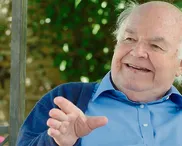
Earlier in the year, John Benton met up with Oxford professor, John Lennox, and talked with him about his recent book Can Science Explain Everything? along with some other topics. Here is the third and final part of their conversation.

John Benton: What do atheist scientists like Peter Atkins and Richard Dawkins say about the intelligibility of the universe? Why are we able to understand it?

John Lennox: Well, they don’t have an answer to it. They are very leery in my experience of entering into that kind of discussion.

I briefly mentioned that in the book. Both C.S. Lewis, a believer, and Thomas Nagel, an atheist, say that if you believe that the mind is the brain and the brain is the end product of a mindless unguided evolutionary process, you are undermining rationality.

I sometimes say: ‘Of course I’m a Christian because of biblical revelation. But also I’m not an atheist because atheism doesn’t simply shoot itself in the foot, it shoots itself in the head, because it destroys rationality.’ Lewis saw that clearly in his book Miracles. But the fact that an atheist like Nagel is pointing this out has really stirred a hornets’ nest.

John Benton: At the beginning of your book you relate how, as a young academic, you were pressurised by senior professors to renounce your Christian faith. How can Christians who are scientists make progress in the academic world without compromising their faith?

John Lennox: It’s very difficult for me to answer that at the age of 75. Countries do vary and certainly I am aware that in certain realms it is increasingly difficult.

But you used the phrase ‘without compromising their faith’. You need always to be careful. Faith in what? If you are going to use the word ‘faith’ anywhere in writing you are up against an audience who will confuse two things. Do you mean your religion? Because we have the great monotheistic faiths, Judaism, Christianity, Islam. That’s using ‘faith’ as a descriptor of religion. But then there’s your personal faith in the living God. And if you just leave the word ‘faith’ dangling in the air, people will misunderstand you. It makes such a difference – their personal faith in God rather than people saying their Christian religion. There’s no problem with religion. But there is with ‘faith’. It’s a hugely confused thing and Dawkins has caused most of it because, you see, ‘faith’ now to many of my colleagues means believing where there is no evidence.

John Benton: Do you think Christians are treated unfairly in academic circles?

John Lennox: I think some have been and some certainly are. There is some discrimination, I think, but there is a Parliamentary Commission investigating this at present. It will be interesting to see what that comes up with.

I have met people who feel they have been discriminated against. I have personally experienced very little. Some of it does go on behind the scenes. It exists. But it is very difficult to talk about because once you open your mouth, unless you have rock-solid evidence, you will just be accused of sour grapes. But, you know, it has to be borne in mind that some believers are pretty awkward characters too.

John Benton: Let’s come away from science for a moment. Is there anything you would want to say to the churches?

John Lennox: It’s a generalisation – which is dangerous – but there is a lack of really expounding Scripture at a level that will stimulate the contemporary mind.

People are professional. Many who come to church have jobs where serious and careful thought is required and they are used to that high level. Then they come to church and hear a sermon that has been fudged off the Internet or something.

We have to bring Scripture and culture together. That’s what I tried to do in my book the Flow: the expounding Daniel (Against inspiration of Daniel in an Age of Relativism). There is often a failure to show people who come to church that Scripture’s authority, at least in part, rests on its answers to the big questions of life. I think preachers have a lot more preparation to do in expounding the word of God.

We need to learn to expound it into the culture – as I learned from my old mentor, Professor David Gooding. He taught me to do this kind of stuff which leaves people with a sense of ‘gosh, Scripture really has got something to say’.

I’ve often been shocked by university Christian Unions. I would be invited to go, turn up and they would say, ‘Now we’ve got 45 minutes of worship and then we want you to speak for 20 minutes.’ And my reply was, ‘Pardon? You mean you are going to sing for 45 minutes until everybody’s tired. Why do you do that? Well, I will talk first and you can sing as long as you like after I’ve gone.’ I did it many times and often the exec. would afterwards come, even weeping and saying ‘We’re sorry. We didn’t realise Scripture was so interesting.’ It’s a huge problem. And you will see it in many churches today.

Sometimes worship leaves much to be desired. There can be mindless repetitions of contentless mantras that aren’t worship. It’s a very narcissistic culture we are developing in some churches. ‘I really want to worship you.’ That’s not a statement of worship. That’s a statement of my feelings about myself.

Forgive me. I’m dead keen on meaningful hymns. My niece Kristen is married to Keith Getty. I introduced them!

John Benton: John Stott used to talk about ‘double listening’ – listening to God’s word and listening to the world in order to know how to apply God’s word to the world. But how can an ordinary pastor be adept at so many subjects?

John Lennox: I can’t answer that. Well, he can’t. And this is the trouble. But then the question comes as to whether you are using the people in your congregation who are adept? I know there comes an objection: ‘Well, if I’m not in the pulpit three Sundays out of four my church council will be on my neck.’ But, you know, I think the early church was much more flexible than we are. We need to use the competent people in our churches.

A lot of people go in and out of church and don’t get engaged. They are consumers. They’re not involved. But are we making the effort to involve them? This is a huge subject. I don’t want to try to be a guru, but it does disturb me.

John Benton: Your book is titled, Can Science Explain Everything? It has an evangelistic edge to it. Suppose an ordinary Christian has an opportunity with a colleague or friend who says, ‘Science has disproved religion’ – what tips would you give for handling that one?

John Lennox: I would encourage this kind of approach. You could say to your non-Christian friend, ‘I’m not an expert on this, but you now you can help me. I’ve come across a book which seems interesting but I don’t know how to evaluate it.’ I tell people not to recommend my books, but to ask people to evaluate them. If you hand that book to somebody and say, ‘Hey, this is a great book’, they will look for every possible problem with it. But if you say, ‘Look, I’m not an expert in this, but I know you’re interested, I’d be very interested in what you think of it’, I find that can get somewhere with people.

CAN SCIENCE EXPLAIN EVERYTHING?
By
John Lennox
The Good Book Company. 128 pages. £7.99
ISBN 978 1 784 984 113

Share
< Previous article| Features| Next article >
Read more articles by John Lennox >>
Features
Can scientists believe in God?

Can scientists believe in God?

Professor John Lennox considers the question and explains the pressures he has been put under as a Christian Surely …

Looking for a job?

Browse all our current job adverts

Search

Need to advertise?

We can help you reach Christians across the country

Find out more