
It is too early as yet to know the impact of the Covid-19 restrictions on church attendance in England.
Many expect it to drop because ‘live-streaming’ has become very popular, and it is much easier to watch on a screen in the comfort of one’s home than travelling to a church on a Sunday. On the other hand, others feel numbers may increase because many more folk have been watching on YouTube or whatever and may feel they want to join in. The issue for church leaders may well be how to accommodate both of these eventualities.
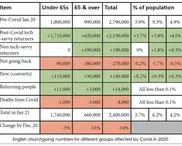
Meanwhile, American researchers did an interesting study. As in the UK, death is the obvious main reason for a decrease in churchgoing numbers; it is estimated that 9,000 English churchgoers will have died because of coronavirus. The second main reason is because churchgoers move house, also as in Britain. So the researchers asked people who had moved whether this meant leaving their existing congregation or not by the distance they had moved.
A ‘long distance’ was defined as crossing a county boundary; the fact that some moves can be across a county boundary but only be a few miles away was ignored for this study. They found that of those moving house, just over a third, 37%, changed their congregation, which of course meant that the others, 63%, did not change their congregation.
Of those not changing their congregation the majority only moved a short distance so staying in the same church was sensible – and of course some might have moved nearer to their church rather than farther away. The other 1% who did move a longer distance enjoyed their church teaching, fellowship and leadership sufficiently to make them feel it was worth still travelling to and fro each Sunday.
Some people change their church without moving! They simply switch congregations, and of the 37% who changed their church, just over half of these, 20%, did so without moving house. They left for other reasons. This survey didn’t ask why they had changed in this context, but other surveys have shown that the usual reason cited is feeling unable to support the leadership, or they experience a change in their relationships, or they have objections to the theology being taught. Very few leave their church because they lose their faith in Christ. The dictum ‘Once a churchgoer, always a churchgoer’ is substantially true.
Those who moved and left their existing church were almost half of the 37% (17%) who changed their congregation. Of this 17%, a third (6%) had moved a long distance so changing their church was presumably just a consequence of moving house to another area. But the other two-thirds (11%) only moved a short distance and presumably could have stayed in their existing congregation had they wished.
The ‘continuity of experience,’ as one paper expressed it, or worshipping with familiar faces, is ‘as meaningful, if not more so, than the personality of the pastor or the diversity of the church’s programmes. The experience of worship is profoundly shaped by the continuity of who is there’.
Churches are often described by their members as families, but families are continuing structures, and it is that continuity that is important, even if others join or leave.
So what does all this tell us? A small proportion of those moving house so like their church that they will stick with it though requiring larger amounts of travel, while almost one in ten, 11%, moving house use that as a reason for changing their church. If someone in your church is moving, some ministers take the opportunity to ask, ‘Where are you going?’ and then suggest suitable new churches they might care to try, and, if necessary, contact those churches in advance on their behalf.
Some who move without considering their new place of worship will often try a local church near where they go, and if they don’t like that church much, will try a second congregation. But if the second congregation doesn’t work for them many will stop going altogether. There is, therefore, a genuine spiritual concern to be taken for those moving house, especially if children are affected and have Sunday groups and young people’s activities.



Is your church healthy? A sabbatical may reveal the answer...
What would you say if I told you that your church has more to gain by a generous sabbatical policy …