
Most analyses about church attendance focus on denomination, churchmanship or people’s age. But looking at the environment (catchment area) can also be of significance.
This is helped by the comprehensive March 2021 Government’s Statistical Digest of Rural England, comparing the English rural and urban populations. Those living in rural towns, villages and hamlets are one-sixth, 16%, of the total population, while those living in urban areas (major and minor conurbations, cities and towns) are 83%, the remaining 1% living in what are called ‘sparse settings,’ mostly remote rural areas.
Churchgoing analyses don’t follow the same classifications, which muddies direct comparisons, but those living in commuter rural areas are 10% of all churchgoers, and those in more remote rural areas (which includes sparse areas) are a further 7%, and the total of these two is 17%, the same as the total in the general population. Urban and suburban churchgoers form the remaining 83%.
Population proportions have not changed over the last ten years, even though both rural and urban populations have increased. Churchgoing proportions have changed slightly, even though the number of churchgoers in both broad areas have decreased. In 2000 the rural proportion of churchgoers was 20% whereas now it is 17% – a 3% difference but actually a loss of 120,000 churchgoers, almost certainly because many in rural areas are elderly and many will have died.
The average age of those living in rural areas is 45, while in urban areas it is 39 (2019 figures). For churchgoers, estimates for 2020 put the rural average age at 51, and the urban average at 50, so there is not the disparity seen in the general population. Why is that? Unlike the general population, measured by just living somewhere, churchgoers are measured by the action of going to church. In rural areas, public transport is less available, and services are held less frequently. It may be that in rural areas it isn’t the case of elderly churchgoers not going to church, but perhaps not being able to get to church. So it is more likely to be the under-80s who are active in rural churchgoing, those older depending on the availability of lifts.
A quarter, 25%, of the overall population in rural areas is 65 or over, and 35% in urban areas. However, for churchgoers the proportions are 37% and 35%, a very great difference for rural churchgoers. Far fewer younger people (under 65) in rural areas are churchgoers – 17% of rural churchgoers are under 20, whereas 24% of the rural population are under 20. Conversely 37% of rural churchgoers are 65 and over but only 24% of the general population. Or, to put it another way, 3% of those living in rural areas who are under 20 go to church, but 7% of those who are 65 or over. The Digest shows that the rural population is currently growing especially by those in their 40s and 50s, who ‘escape to the country’ for a quieter, more peaceful lifestyle, and combine commuting with ‘working from home’.
The percentage of churchgoers in each of the environments for church attendance (green rows) is shown in the table below, as is the average size of congregation (red rows).
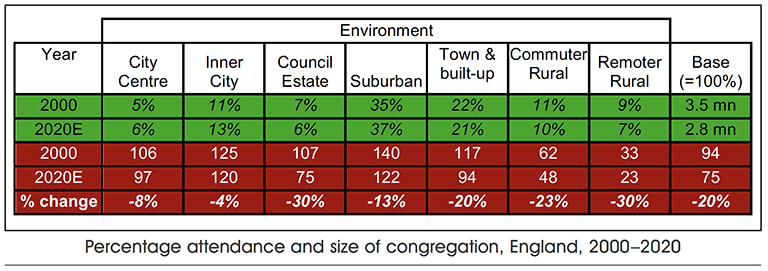
The bottom line shows the percentage drop in average congregation size over the past 20 years. The largest drops are in Remoter Rural attendance and on Council Estates. The smallest drop is in the Inner City areas where so many Pentecostal churches are located. The last column shows we have lost a fifth of our churchgoers in the last 20 years, an average of about 1% per year.
There are only three environments where the percentage of churchgoers in 2020 is greater than in 2000 – City Centres (growth to growing larger churches), Inner City (growth due to the planting of many Pentecostal churches as well as congregational growth) and Suburban areas (also where many church plants have taken place).


Is your church healthy? A sabbatical may reveal the answer...
What would you say if I told you that your church has more to gain by a generous sabbatical policy …