On holiday in Cameroon, Alison Baverstock recently had the opportunity to visit CABTAL (Cameroon Association for Bible Translation and Literacy), a partner of Wycliffe Bible Translators. She writes:
Making connections through stories has been my lifelong preoccupation. What you have read in common can prompt communication, deepen understanding and promote empathy.
So it should not have surprised me that a dramatic telling of the story of David and Goliath should be so impactful. The hush of the audience, the gestures and voice-modulations of the speaker, and above all his calm conclusion, created huge common ground. I joined firstly the silence, and then the restrained applause and murmuring that followed.
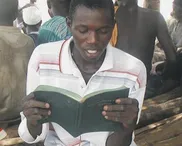
This storytelling was part of a session organised by CABTAL, an organisation that facilitates Bible translation so that the word of God can be truly heard by local people. There are at least 270 languages in Cameroon, and more demand than they can fulfil. So they insist that any collaboration must be grounded in local practical action: recruitment of capable, committed individuals to be trained in translation; a strong local structure for project management; shared commitment to project resourcing – either in money or kind – which will supplement CABTAL’s investment.
A project can run for ten years. Where there is no written form of the language, a script is developed. Translation usually begins with Luke, because the JESUS film is based on that Gospel, and then proceeds to dubbing the film into the relevant language.
‘Why not use subtitles?’ I asked, assuming this would be significantly cheaper.
‘It is important that they hear the words of Jesus in their own language,’ said Wilfred Mbori, CABTAL’s Director of Operations and Development. And, of course, subtitles only work if you can read. Cameroon’s literacy rate is around 77%.
School attendance in Cameroon is patchy, particularly in the regions where there is conflict. CABTAL’s literacy programmes, delivered through churches and schools, bring greater opportunities for employment and education, as well as day-to-day benefits like the ability to read medication instructions.
The meeting took place in the town of Nanga-Eboko, 160km north-east of the capital, Yaoundé. It took us about four hours to get there, slowed by traffic-jams, markets and checkpoints. At one checkpoint, consideration of a rather tired-looking fire extinguisher by the police officer turned to enthusiasm as he realised what the team was doing – and how his own community had benefitted. He beamed broadly and swiftly blessed our departing vehicle.
What did I learn? Well, firstly how the organisation operates, where else it has been successful and the impact it has had. CABTAL is very strong on project evaluation. The teams monitor various aspects of engagement: reading the text; participating in activities such as literacy classes and Bible study; involvement within the wider community (for example as a storyteller or discussion leader).
Secondly, the value that is placed on the Bible. We can get so used to having access to the Bible that we take it for granted. Here it is precious.
Thirdly, I was reminded of the immediacy of Bible stories. Asking Wilfred’s team about stories that particularly resonate, I was told Zacchaeus is a good example; the community pariah who is asked down from a tree in order to eat with Jesus. And if he could find acceptance, so can all sinners.
Fourthly, the importance of community collaboration. People had travelled far to be together. A local government official hosted the meeting. Two priests gave the welcome.
Finally, and I think most movingly, was the serenity of the event. There was a studied and quiet attention; stillness; calm. No riotous applause. Rather a palpable sense of concentration, and then an enhanced sense of connection. We had our photographs taken together afterwards – squeezing people into gaps to ensure everyone was visible. The event finished with a meal.
Nanga-Eboko is a former French colonial town. There remain dilapidated colonial buildings and the local economy relies on extensive sugar plantations, with management still under French control.
But here, now, something even more deep-rooted is taking place. A persistent, growing attachment to the word of God, embedded within ecclesiastical, administrative and government structures. Whatever our background, wherever we are in the world, the Bible stories we hold in common are both precious and uniting.
Alison is the Founder and Director of Reading Force, which aims to keep Forces families close and connected through sharing stories. www.readingforce.org.uk