
Rebecca Chapman speaks to Krish Kandiah.
Dr Kandiah (see photo) is a social entrepreneur with a vision to help solve some of society’s seemingly intractable problems through building partnerships across civil society, faith communities, government, and philanthropy.
He has spoken at the Keswick Convention, taken part in an FIEC webinar with John Stevens, and is the author of several books including Route 66: a Crash Course in Navigating Life with the Bible.
Formerly with Home for Good, he is now Chair of the Adoption and Special Guardianship Leadership Board where he brings strategic leadership to the finding of permanent loving families for children in the care system working across the sector and advising the English government.
He is also director of Sanctuary Foundation.org.uk which seeks to promote refugee welcome and welfare and currently holds a faculty position at Regent’s College, Vancouver.
en: Tell me a little bit about your background?
KK: I was born in Brighton to mixed ethnicity parents – my mum was from India, my dad was from Malaysia.
I became a Christian when I was 15, through a friend at school sharing his faith with me. I went on to university with a plan to be a missionary in the former Soviet Union – I was going to be a chemist by day, and a missionary by night – but I got involved in the Christian Union movement and became a relay worker for UCCF.
Then my wife and I became missionaries in Albania, leading the IFES team there. When we came back, I decided I needed more theological study, so first I worked at a church in Warwick, while studying for an MA in missiology, and then did a PhD while pastoring a church in Harrow. I went on to work in Oxford, teaching vicars about mission and apologetics, before joining the staff team at the Evangelical Alliance. I then started a fostering and adoption charity called Home for Good, before my current role advising the government on adoption and special guardianship. And I’m a social entrepreneur with the rest of my time!
en:. What does that phrase ‘social entrepreneur’ mean?
KK: I was looking for a word to describe bringing innovation into fixing social problems. We are foster parents and adoptive parents, and birth parents, and we’ve been trying to see what we could do to change the system for many years.
Now I’ve moved into the area around refugees, hosting and welcoming, but also housing. Anyone that’s trying to innovate in those spaces I describe as ‘social entrepreneurs’, which hopefully signals to people inside and outside the church that we’re trying to do some good.
en: You mentioned being a missionary, training vicars, studying theology. How do you think all those different roles helped you in what you’re doing now?
KK: Looking back I can see how all the threads fit together. I had a really helpful grounding in Biblical exposition as a student, that was absolutely my bedrock, both as a learner and also as a preacher. That’s been the backbone of everything: what does the Scripture have to say about our responsibility to widows and orphans, and about our relationship with the state? A phrase that we learned at UCCF was to encourage the good wherever you find it – when you do that in government, doors open. There’s a lot of criticism, a lot of throwing each other under the bus. But when you say to a minister or a civil servant ‘what you did there was brilliant, how can we help you to do more of that?’, they respond. Communication opens doors as well. I do a lot of work in the media, to Christian audiences and secular audiences. All of that apprenticeship, in all those different roles, has helped me champion the cause of Christ in all sorts of different places.
en: How do you think those secular audiences see Christians?
KK: In my lecture this summer at Keswick I quoted some statistics that really shaped me – when you ask 16–29-year-olds what they think of Christianity, particularly evangelical Christianity, the headline figures are pretty scary. I think if we can call the church back to walking in the footsteps of Christ, so that even our enemies are accusing us of being too welcoming, something will be going right.
en: You’ve got birth children, adopted children, foster children – what have you personally found most challenging and most rewarding about your blended family?
KK: It’s rewarding at a number of levels. It took me a long time to see it, but now I can’t unsee in Scripture just how much hospitality is a defining feature of the Christian life. Whether you’re looking at James 1.27, where we’re told ‘religion that God our Father accepts as pure and faultless is this: to look after orphans and widows’, or Matthew 25 with the parable of the sheep and the goats. The determining factor of whether you are in the kingdom is how you’ve responded to the hungry, the thirsty, the sick, and the imprisoned.
There’s also incredible joy in seeing children who have had such a difficult start in life begin to flourish. Small victories become super-important. Our youngest daughter had speech delay and still struggles, she’s in a special-needs school. But the other day she was telling jokes around our dinner table with visitors. A year ago, that would have been impossible. It’s incredible joy seeing children using their skills and gifts and flourishing. You realise the challenges when you discover just how many children in the nation don’t have a loving family around them. The statistics around children who have aged out of care, ending up either exploited, homeless or criminalised, are heartbreaking. The church in general is doing a good job, I think we’re really stepping up, but there’s still a long way to go.
en: What were you most surprised by when you began to learn more about the care system?
KK: I didn’t realise until quite late in my life just how many children are waiting for adoption, and how most adopters aren’t able or aren’t willing to take the children that are actually in the system. Infertility is the main driver for people to adopt in the UK; often there is an idealised picture of the children that people would like to adopt. Older children, sibling groups, children with additional needs, children from different ethnicities, are just left behind, left in the system. It’s so exciting when people come forward and realise you don’t have to be infertile to be a brilliant adopter – all sorts of people can do it. We’ve met millennials that have adopted without even trying to have their own birth children, as a particular calling, and single people that have adopted and had the support of their church to wrap around them. Older people are adopting, having had a kind of first tranche of children, that’s been really exciting.
en: How do you think that the churches’ perception of adoption and fostering has changed since you founded Home for Good?
KK: It’s been encouraging to see the vision of the church as the people of God that there was in the early church return – the vision that we are the kind of people that would welcome those that are most needy. I think gradually we’re singing more songs that celebrate our adoption into God’s family. It used to be only ‘Father God, I wonder’. Now it’s not unusual for a Hillsong, or a Bethel song, to celebrate adoption. I think once we begin to appreciate our adoption into God’s family more, that softens our heart to think about offering adoptive homes to children that need them. I had that conversation with J.I. Packer before he died, and that was his story, he’s an adoptive dad. If you read Knowing God, he says ‘adoption is the highest privilege that the gospel affords’; it’s interesting that adoption has been under-appreciated as a doctrine for a long time.
en: In 2020, you were appointed as Chair of the Adoption and Special Guardianship Leadership Board. What does that role look like?
KK: I advise the government on adoption and special guardianship – that’s often kids living with their grandparents, aunties and uncles, because mum and dad are not able to care for them. It brings together government, third sector, social work, and legislature. My ambition is to put the child in the centre of the system. We often say adoption isn’t about finding children for families, but families for children. I feel sometimes I’m like the fox that’s been let in the henhouse – I’m an adopter, I’m a foster parent. To have that lived experience, and then to bring it into a system to bring about change is amazing.
Often, Christians take what is described as a John the Baptist approach to political engagement. Someone does need to call out injustice and evil and hypocrisy, but there’s also what I describe as a Daniel role. We’re all just taking notes from great Biblical heroes like Joseph, Daniel, Esther and Nehemiah. They worked inside government trying to find solutions. I look for opportunities, and what I describe as overlapping ambition. The government has a statutory responsibility to care for vulnerable people; the church has a spiritual mandate to care for vulnerable people, so we can help! In my role in government, I’m not there because I’m a Christian. But my Christian faith comes with me wherever I go. I’m looking for solutions that work right across society. It’s a privilege.
en: There has been a lot of change in government this year – has that has any impact on the work that you do?
KK: Yes, lots. It means you never get up to pace, you never get any speed. With the previous two ministers I had built the relationship, built the trust, come up with an idea, and was about to get to deliver something… then suddenly they’re gone, and you’ve got to start all over again. It’s likely we’ve only got two years until a change of government. It’s incredibly frustrating – like a sprint, but you have to stop every ten metres and start again. I find that really hard. It’s the Nehemiah and Daniel model again; there are really good civil servants, and without them nothing would happen, because the politics change so quickly. I meet so many Christians there who feel a calling to serve in that way. I think we often tell people to get into politics, become a cross-cultural missionary, or become a pastor. But I think there really are Daniel, Nehemiah, and Esther callings. Christians can do a lot of good in those places.
en: It is now about two and a half years since George Floyd and the start of the Black Lives Matter movement. Which bits of the past specifically do you think it’s really important for the church to address?
KK: Part of the reason for the Hong Kong welcome was because I found out that this movement of people from Hong Kong to the UK is the largest planned migration to the UK from outside of Europe since Windrush. We the culture, and we the church, did such a terrible job then.
I’ve heard countless stories from the children of the Windrush generation about how their mum and dad turned up at church, the same church that they’d been part of in the West Indies, whether they were Anglicans or Baptists or Catholic, and they’d come to the Home Church, but were told, thank you very much for coming, but wouldn’t you feel more comfortable (and our congregation would feel more comfortable) if you went down the road and worshipped with people like yourselves? I think we were racist. We were not welcoming, even of people who share our faith, our brothers and sisters. I thought we needed to reverse that. And that’s why I wanted the church to be front of the queue with Hong Kong-ers, and that’s been amazing.
But there are a lot of issues. My wife and I wrote a book called Whistlestop Tales during lockdown to help 8–13-year-olds to celebrate that God really does love the whole world. As a child growing up, I thought everybody in the Bible was white, but as an adult reading the Bible, you realise hardly anybody in the Bible was white. So we picked stories from the Old and New Testament to celebrate the global, all-encompassing love of God. All illustrated brilliantly by Andy Gray, who made sure that no-one in the pictures is unshaded, because even for me as a brown person, if I see someone unshaded, I automatically assume they’re white. I discovered a pretty tragic statistic recently that in America, the group of people most likely to oppose welcoming refugees were white evangelicals. More than Muslims, or atheists, white evangelicals would actually oppose helping refugees. I think some of that is because we’ve misunderstood – we haven’t fully grasped that God genuinely loves the whole world. I want kids and parents and everyone else to understand that love.
en: Do you think we still have a problem in the church with racial prejudice?
KK: Definitely, sadly – we are on a journey. I think one of the interesting reactions to George Floyd was to make critical race theory public enemy number one. For me, that’s throwing the baby out with the bathwater. Paul in Acts 17 takes a very discerning approach to the culture. He says, ‘you’re completely wrong, he is not served by human hands, as if he needed anything’ – he’s challenging the culture. But it also says: ‘In him we live and move and have our being,’ where he’s quoting a pagan poet. He takes a discerning approach. I think we need to do the same with critical race theory. There are aspects that are definitely not things that we can endorse as Christians, but there are some bits of it that are good. Rather than dismissing it, making it look like the church doesn’t actually care about race, becoming anti-woke and closing down the conversation, we need to have the humility to say sometimes we Christians have become syncretised with the world, and with racial prejudices, and we need to fight that. We do that by listening to Scripture, but also listening to people who have experienced racism and ostracism.
One example, in an area that’s close to my heart, is that Christians are supporting orphanages all around the world. We are the biggest funder, we are the biggest visitor, and biggest initiator of new orphanage projects. Most people that would support an orphanage, don’t think that an orphanage is an appropriate way for their own children to be cared for. If my wife and I were to die, we would want our – my, or my wife’s – sisters to take in our children. That’s normal. But in most of the parts of the world that have orphanages, particularly those supported by Christians, those kids have mums and dads. They’re not actually orphans. We’ve got this kind of two-tier system in that what we would never want for our children we are willing to export to other countries. It’s a huge challenge. If you look at some of the ways that Christians market aid and development, and missionary work, it’s often white people going in to rescue black people. I think we need to have a long hard look at that and say actually, there is no hierarchy of races. We believe that every single human being is made in the image of God. We need to find ways to partner with, to learn from, to work alongside those from other cultures, so that we can grow together. If we don’t undo that colonial spirit… we already have a huge challenge with the lack of diversity in our churches, and it can look like we’re racist because of who’s on the platform, who’s on the leadership team. We have a huge challenge, and we need to unpick it.
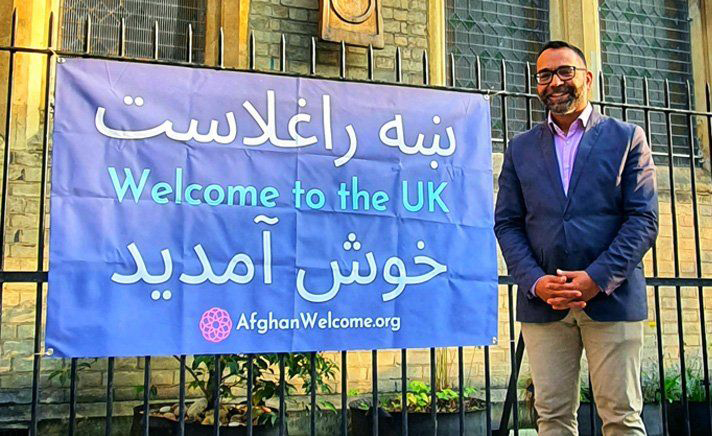
en: How have you have you got an organisation like the Sanctuary Foundation up and running so fast?
KK: It is the grace of God, and incredibly generous individuals and churches that have caught the vision. We set up a little website on a Friday morning, and asked people to volunteer for a programme that didn’t exist. We thought if we could get enough people, then government would see that the nation was up for it. By close of play on Friday we had a few hundred sign-ups, then over the weekend, a few thousand. Then BBC Breakfast got hold of it and sign ups jumped from 7,000 to 15,000, then went up to 30,000. We started to run training for people that wanted to host, and then the government opened its scheme. And 100,000 people stepped forward!
I was so encouraged at Keswick this year – I was interviewed on the main stage, and I said ‘put your hand up if you or someone in your close circle of friends is hosting someone in their home’. About three quarters of the room put their hand up. In the last two years, there’s been the Hong Kong migration, the Afghan resettlement and now Ukraine. Each time, we’ve been able to mobilise churches and charities to play a role. It’s been a joy to be able to go to Downing Street, or the Home Secretary, and be able to present what the church can do. We’re not just a talking shop, we’re actually delivering. We are trying to help vulnerable people, but when we can demonstrate what it is to be the church, I think that opens loads of doors for us into the future.
en: How can Christians and churches get more involved?
KK: Our refugee support course is a great thing to do – most people have had no training, no experience working with refugees or vulnerable people. Our training is available to anybody, whether they’re Christian or not, whether they’re hosting or not. It’s for anyone that might have a touch point with refugees. It covers things like safeguarding – to make sure you’re safe and that you’re keeping other people safe, working cross-culturally, and working with people that have experienced trauma. Because trauma is invisible, you can’t tell the challenges that people have had, and you need to keep reminding yourself of that. There’s an imbalance of power when you’re working with someone who has experienced trauma – they might not look it but they’re vulnerable.
en: What next for the Sanctuary Foundation?
KK: One big issue is housing. Many of the hosting situations for Ukrainians are coming to a natural end, and it’s very difficult to rent properties in the areas where they are currently settled.
We’re working on number of projects that might help. One is to build quick modular housing, that can be set up in weeks, taken down if necessary, after a number of years. I’m talking to one church that has a site that they would love to develop but they haven’t got any cash. If we can provide this quickly, set it up and run it for five years, it will generate an income for the church, and the church can offer those who live there some support. Then, if they do want to go on to develop on that site, we can move the housing elsewhere. Providing five years or so gives a good amount of time for people to get a kind of foothold into a new community. If there are other churches interested in that kind of project, we would love to talk to you.
We’re also really passionate about helping Ukrainian children to integrate. We’re making 20,000 copies of a little welcome book, full of practical tips – on how our culture works, how money works, and then loads of welcome messages, from people like Bear Grylls, Zoe Ball, Mel Giedroyc, and the Ukrainian national football goalkeeper. If churches are working with Ukrainian children, the Sanctuary Foundation can send them 20 free copies.
en: Have you got a favourite family Christmas tradition?
KK: Because we’re foster parents, we have a lot to do with the birth parents of our foster children. We love spending time with our kids’ birth parents, so around Christmas we’ll go and have time together with them and our foster kids as one of our Christmas traditions. It’s so important to us that we help children who are in care to keep their connections with their wider family.
en: What’s your favourite Christmas carol and why?
KK: I’m a huge fan of ‘Hark the Herald’ – you are singing pure doctrine and it’s just so beautifully put. But I also like ‘O come, o come, Emmanuel’ I think it’s the beautifully dark grunge carol that Nirvana would have written. It’s recognising the brokenness of our world and that we need Jesus to come. Those are my two favourites.

'Keir Starmer, please don't apologise to me'
Keir Starmer has apologised to me.On 2 July, he stood up in Parliament and apologised to mothers and adoptees …