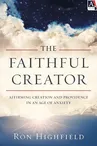
THE FAITHFUL CREATOR:
Affirming Creation and Providence in an Age
of Anxiety
By Ron Highfield
IVP (Apollos). 394 pages. £19.99
ISBN 978 1 783 593 729
Ron Highfield is Professor of Religion at Pepperdine University in California. He was the co-author of Four Views on Divine Providence in the well-known ‘Four Views’ series, so he knows the ins and outs of this subject, as this engaging and well-written book confirms.
It is divided into three parts: the first on creation; the second on the divine providence implied in creation and the Creator-creature relation; and the third on the challenge of evil.
The author desires to ground his exposition of the faithfulness of God in Scripture and then to open out the discussion to challenges and interpretation of the problems. Capital to the whole of the exposition is creation ex nihilo, which establishes ‘that the God-creature relation is unlike any creature-creature relation’. (p.142) This understanding has consequences, and correctly so, for the author’s view of the means or the ‘how’ of creation: ‘There is no mean between absolutely nothing and the world God created. God is the creator of everything, time, space and everything in them.’ To speak of evolution or the Big Bang as the means of creation is a rationalist dream. (p.159) This does not prevent Highfield from engaging with the likes of Polkinghorne, Gould and Dawkins on the way.
Discussion of views
The second part develops a biblical theology that permits a definition of providence and its unfolding, and leads to a discussion of various views: the foreknowledge, the omnipotence and the open theist models. Highfield rejects the Molinist view of middle knowledge, preferring to think that ‘perfect providence would include the perfect execution of the perfect plan’ (p.239), but he will not go as far as Edwards or Helm when he discusses the relation of providence and freedom, preferring the way of Aquinas. Concerning open theism, however, Highfield is clear. He makes a detailed critique of Gregory Boyd’s view that God limits his control of things so as not to compromise their freedom. He concludes that this is unsatisfactory and that it implies modification of certain divine attributes, particularly omniscience. The result is unsatisfactory as far as the faithfulness of God is concerned, and undermines hope in God’s care and hope for the victory over evil.
Finally, in the third part, the author deals with evil in the context of God’s faithfulness to his creation. Why does God leave his creatures vulnerable to error and corruption? There is no present answer to this enigma, other than ‘God knows’ and trusting that he will make good his promises (p.321). After interesting discussion of the rhetorical and the philosophical narratives on evil, including a fine presentation of the popular ‘protest atheism’ of Ivan Karamazov, the final chapter is appropriately entitled ‘Do not be afraid’.
Highfield’s book covers the subject well and does not duck the difficulties. It is biblical, readable and up-to-date, packed with information and good analysis. The hope it expresses is heart-warming.