Like many countries in the world, Australia conducts regular censuses of its population. Unlike many countries, however, Australia holds them every five years (instead of ten, like the UK).
This is very useful for identifying trends in the data. Like many countries, Australia includes a question asking for a person’s religion, but unlike many other countries the question is framed to ask for the respondent’s specific denomination or other religious affiliation.
As a consequence it conveys a good overview of Australian religious adherence. In 2011, some 60% of Australians said they were Christian, 9% belonged to other religions, 22% had no religion and 9% did not answer the question (in a population of 22million). The respective figures for the UK in 2011 were 59%, 8%, 26% and 7%, all very similar in a population of 63million – three times the size.
By 2016, however, the latest year for which figures are available, the Australian figures had become, respectively, 51%, 10%, 30% and 9%, indicating a trend away from Christianity towards No Religion, a trend which many people expect to see repeated in the UK in its next census in 2021. These broad trends are being seen in many other Western countries also, not least in the United States.
Because of its detail, the Australian data allows us to dig a little deeper. There are perhaps five major denominations in Australia – Anglicans, Roman Catholics, the Uniting Church, Presbyterians, and the Orthodox, which together in 2016 accounted for 86% of all those calling themselves Christian (it was 89% in 2006). Of these, the Anglicans accounted for 26%, the Catholics for 44%, the Uniting Church for 7%, the Presbyterians for 4% and the Orthodox for 5%.
The Anglican church is declining (-1.8% average per year between 2006 and 2016), the Catholic Church is growing (slowly at +0.3%), the Uniting Church is declining (quite rapidly at -2.7%), the Presbyterians and the Orthodox are also both declining (-1.3% and -0.5% respectively). By comparison with these figures, the results show that two other denominations are growing at a significant rate –the Pentecostals (+1.7%) and the Seventh-Day Adventists (+1.3%), both of which are strongly Black and Charismatic, but between them these are only 3% of all the Australian Christians.
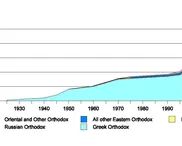
It will be noticed from the chart that the ‘All Others’ group is growing, and the key reason for that are those Christians who are not aligning themselves with any of the 12 stated denominations, which the census authorities call ‘Other Christians’. In a secular context, Reed Hastings, a key businessman, recently wrote a book (with Erin Meyer) in which he showed how his start-up technological company had done so well. It was called ‘No Rules’ Rules, describing how ‘Netflix and the culture of re-invention’ had done so brilliantly for the streaming service.
The same kind of culture is working in the Christian church. The ‘No Denomination’ Denomination is doing very well, thank you, and the Australian figures show it has been growing at the very rapid rate of +6.4% per annum for the decade 2006 to 2016. Unfortunately we can’t make any parallels from the UK census figures as the latter does not count individual numbers in each denomination. There is no obvious equivalent in the UK to ‘non-denominational Christians’ unless one considers those attending Messy Church as such. While there are commonalities between these 3,000+ Messy Church groups, they are not a single denomination in any way. But their numbers have risen at an annual rate between 2010 and 2020 of +21.7% – three times as fast as the Australian no-denomination Christians!
While the UK Pentecostals have dozens of small denominations which might broadly be called ‘Pentecostal’, in reality many of these are led by entrepreneurs keenly committed to the gospel for whom anything that helps advance the Kingdom is worth trying – No Rules rules! Pentecostal attendance in England has grown at the rate of +2.4% between 2010 and 2020 and in Scotland at +2.6%, on a par with the Australian increases. Is this a key feature of current church growth – allowing people to reach out in any way they can, without church or denominational rules and regulations to hinder them?